6 Promptly report any lumps, masses, or changes to the physician.
| 1 lf possible, take a warm bath or shower before beginning; the scrotum, which tends to contract when cold, will be relaxed, making the testes easier to examine. |
5
Next, examine each
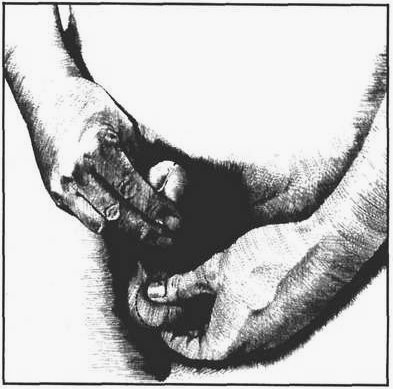
testis. To do so, place the index and middle fingers on its underside and the thumb on top, then
gently roll the testis between the thumb and fingers. A normal testis is egg-shaped,
rubbery-firm, and movable within the scrotum; it should feel smooth, with no lumps. Both testes
should be the same size.
6 Promptly report any lumps, masses, or changes to the physician. |
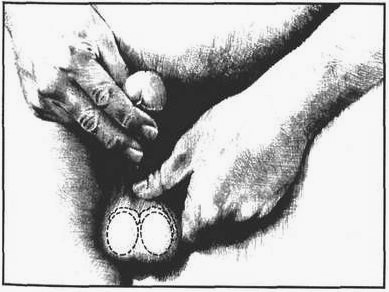
| 2 With one hand, lift the penis and check the scrotum (the sac containing the testes) for any change in shape, size, or color. The left side of the scrotum normally hangs slightly lower than the right. | |
| 3 Next, check the testes for lumps and masses. Locate the crescent-shaped structure at the back of each testis. This is the epididymis, which should feel soft. | |
|
4
Use the thumb and
first two fingers of your left hand to squeeze the spermatic cord gently; it extends upward from
the epididymis, above the left testis. Then repeat on the right side, using your right hand.
Check for lumps and masses by palpating along the entire length of the cord.
|