1. Breast cancer

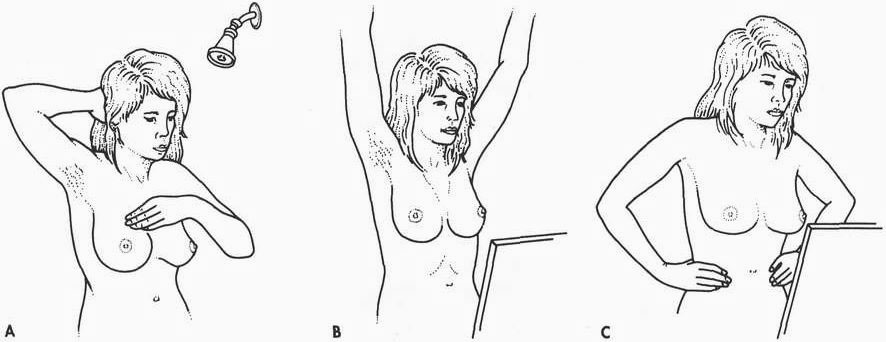
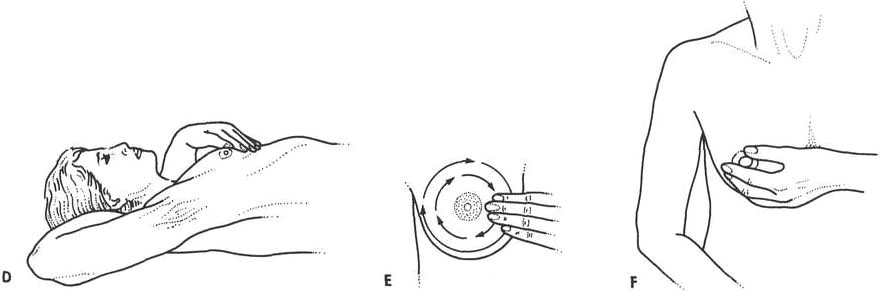
Breast self-examination. (A) Examine breasts during bath or shower because flat fingers glide easily over wet skin. Use right hand to examine left breast and vice versa. (B) Sit or stand before a mirror. Inspect breasts with hands at sides, then raised overhead. Look for changes in contour or dimpling of skin. (C) Place hands on hips and press down firmly to flex chest muscles. (D) Lie down with one hand under head and pillow or folded towel under that scapula. (E) Palpate that breast with the other hand using concentric circle method. It usually takes three circles to cover all breast tissue. Include the tail of the breast and the axilla. Repeat with other breast. (F) End in a sitting position. Palpate the areola areas of both breasts, and inspect and squeeze nipples to check for discharge.
  1. Uterine cancer (endometrial): originates from epithelial tissues of the endometrium; second only to cervical cancer as cause of pelvic cancer. Slow growing; metastasizes late; responsive to therapy with early diagnosis; Pap test not as effective - more effective to have endometrial tissue sample.


Papanicolaou-Smear Classes

Class Recommended Actions
0 Normal
I Atypical cells, nonmalignant Treat vaginal infections; repeat Pap smears
II Suspicious cells Biopsy; dilation and curettage
III Abnormal cells; suspicious of malignancy Biopsy; dilation and curettage; conization
IV Abnormal cells; suspicious of malignancy Biopsy; dilation and curettage; conization
V Malignant cells present

Uterine Cancer: Recommended Treatment, by Stage of Invasion

Stage of Invasion Recommended Treatment
0 (In situ) Atypical hyperplasia Cryosurgery, conization
I Uterus is of normal size Hysterectomy
II Uterus slightly enlarged, but tumor is undifferentiated Radiation implant, x-ray; hysterectomy 4-6 weeks postradiation
III Uterus enlarged, tumor extends outside uterus Radiation implant, total hysterectomy 4-6 weeks postradiation
IV Advanced metastatic disease Radiation, chemotherapy; progestin therapy to reduce pulmonary lesions

International System of Staging for Cervical Carcinoma

Stage Location Prognosis Treatment
0 In situ Highly curable Conization
I Cervix Cure rate decreases as stage progresses Radiation
II Cervix to upper vagina Radiation
III Cervix to pelvic wall or lower third of vagina Surgeries:
  1. Panhysterectomy, wide vaginal excision with removal orlymph nodes; ileal conduit
  2. Pelvic exenteration:
    • Anterior: removal of vagina and bladder; ileal conduit
    • Posterior: removal of rectum and vagina; colostomy
    • Total: both anterior and posterior
  3. Chemotherapy
IV Cervix to true pelvis, bladder, or rectum

  1. Prostate cancer: malignant neoplasm, usually adenocarcinoma; most common cause of cancer in men.