Conditions Affecting Gas Transport
| Class | Description |
| 0 | No TB exposure, not infected. |
| 1 | TB exposure, no evidence of infection. |
| 2 | TB infection, no disease. |
| 3 | TB: current disease (persons with completed diagnostic evidence of TB - both a significant reaction to tuberculin skin test and clinical or x-ray evidence of disease). |
| 4 | TB: no current disease (persons with previous history of TB or with abnormal x-ray films but no significant tuberculin skin test reaction or clinical evidence). |
| 5 | TB: suspected (diagnosis pending) (used during diagnostic testing period of suspected persons, for no longer than 3 month). |
Airborne and Droplet Precautions
_________________________________________________________________________________________________________________________________________________
|
When Used
Precautions
|
Differentiating Between Causes of Dyspnea
| Asthma | Chronic Obstructive Pulmonary Disease | Pneumothorax | Pulmonary Edema | Pulmonary Emboli | |
| Characteristics |
Episodic, acute
History of allergies Recent cold or flu |
History of emphysema, bronchitis
Heavy smoker Recent cold or respiratory infection |
Chest pain: sudden, sharp
Sudden onset; associated with coughing, air travel, strenuous exertion |
History of myocardial infarction
Rapid weight gain Cough Taking diuretics Increasing need forpillows for sleep |
Sudden dyspnea
Sharp chest pain Recent immobilization, surgery, or fracture of lower extremeties History of thrombophlebitis, use of birth control pills, sickle cell anemia |
| Assessment Findings |
Wheezing
Hyperresonance Chest may be silent with bronchospasms |
Use of pursed-lip breathing
Wheezing, crackles “Barrel” chest Uses accessory muscles to breathe |
Tracheal deviation Asymmetrical chest motion Diminished breath sounds |
Crackles
Pink, frothy sputum Gallop (S3) Air hunger |
Tachycardia
Hypotension Tachypnea Pleural rub |
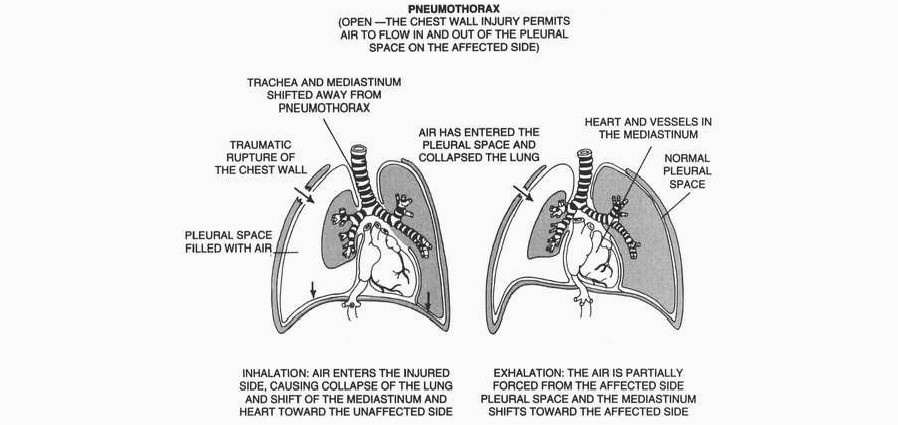
PNEUMOTHORAX
Comparison of Pneumothorax and Hemothorax
|
|