-
Assumptions and key ideas
- No human behavior is accidental; each psychic event is determined by preceding ones.
- Unconscious mental processes occur with great frequency and significance.
- Psychoanalysis is used to uncover childhood trauma, which may involve conflict and repressed feelings.
- Psychoanalytic methods are used: therapeutic alliance, transference, regression, dream association, catharsis.
-
Freud-shifted from classification of behavior to understanding and explaining in psychological terms and changing behavior under structured conditions.
- Structure of the mind: id, ego, superego; unconscious, preconscious, conscious.
- Stages of psychosexual development.
- Coping mechanisms
- Erik Erikson-Eight Stages of Man (1963)
- Psychosocial development-interplay of biology with social factors, encompassing total life span, from birth to death, in progressive developmental tasks.
- Stages of life cycle-life consists of a series of developmental phases.
- Universal sequence of biological, social, psychological events.
- Each person experiences a series of normative conflicts and crises and thus needs to accomplish specific psychosocial tasks.
- Two opposing energies (positive and negative forces) coexist and must be synthesized.
- How each age-specific task is accomplished influences the developmental progress of the next phase and the ability to deal with life.
- Abraham Maslow-Hierarchy of Needs (1962)
- Beliefs regarding emotional health based on a comprehensive, multidisciplinary approach to human problems, involving all aspects of functioning.
- Premise: mental illness cannot be understood without prior knowledge of mental health.
- Focus: positive aspects of human behavior (contentment, joy, happiness).
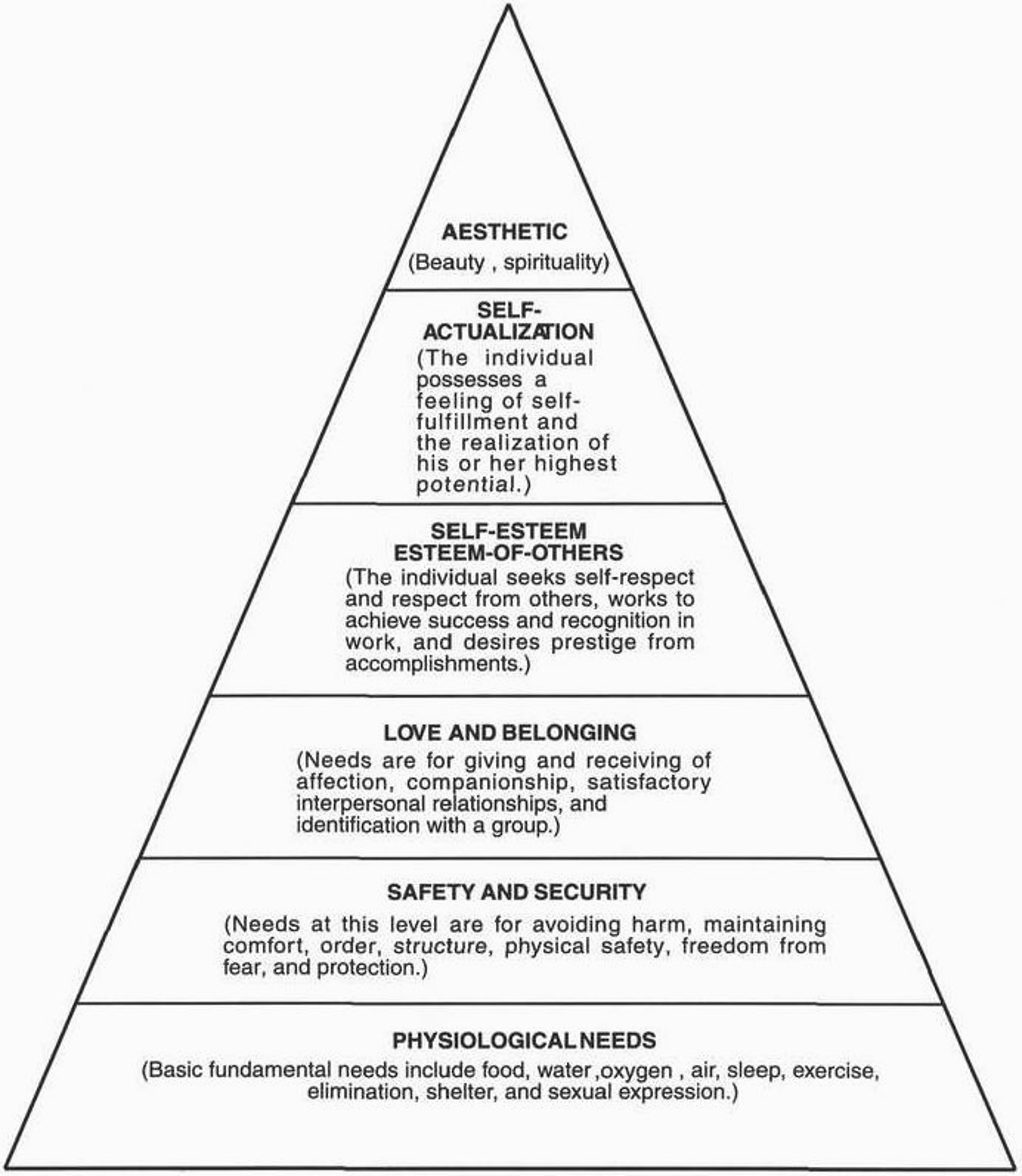
- Hierarchy of needs-physiological, safety, love and belonging, self-esteem and self-recognition, self-actualization, aesthetic. As each stage is mastered, the next stage becomes dominant.
- Characteristics of optimal mental health- keep in mind that wellness is on a continuum with cultural variations.
- Self-esteem: entails self-confidence and self-acceptance.
- Self-knowledge: involves accurate selfperception of strengths and limitations.
- Satisfying interpersonal relationships: able to meet reciprocal emotional needs through collaboration rather than exploitation or power struggles or jealousy; able to make full commitments in close relationships.
- Environmental mastery: can adapt, change, and solve problems effectively; can make decisions, choose from alternatives, and predict consequences. Actions are conscious, not impulsive.
- Stress-management: can delay seeking gratification and relief; does not blame or dwell on past; assumes self-responsibility; either modifies own expectations, seeks substitutes, or withdraws from stressful situation when cannot reduce stress.
- Beliefs regarding emotional health based on a comprehensive, multidisciplinary approach to human problems, involving all aspects of functioning.
- Jean Piaget-Cognitive and Intellectual Development (1963)
- Assumptions-child development is steered by interaction of environmental and genetic influences; therefore focus is on environmental and social forces.
- Key concepts
- Assimilation: process of acquiring new knowledge, skills, and insights by using what they already know and have.
- Accommodation: adjusts to change by solving previously unsolvable problems because of newly assimilated knowledge.
- Adaptation: coping process to handle environmental demands.
- Age-specific development levels-sensorimotor, preconceptual, intuitive, concrete, formal operational thought.
- E. M. Duvall-Family Development (1971)-developmental tasks are family oriented, presented in eight stages throughout the life cycle.
- Married couple
- Establishing relationship.
- Defining mutual goals.
- Developing intimacy: issues of dependence-independence-interdependence.
- Establishing mutually satisfying relationship.
- Negotiating boundaries of couple with families.
- Discussing issue of childbearing.
- Childbearing years
- Working out authority, responsibility, and caretaker roles.
- Having children and forming new unit.
- Facilitating child’s trust.
- Need for personal time and space while sharing with each other and child.
- Preschool-age years
- Experiencing changes in energy.
- Continuing development as couple, parents, family.
- Establishing own family traditions without guilt related to breaks with tradition.
- School-age years
- Establishing new roles in work.
- Children’s school activities interfering with family activities.
- Teenage years
- Parents continue to develop roles in community other than with children.
- Children experience freedom while accepting responsibility for actions.
- Struggle with parents in emancipation process.
- Family value system is challenged.
- Couple relationships may be strong or weak depending on responses to needs.
- Families as launching centers
- Young adults launched with rites of passage.
- Changes in couple’s relationship due to empty nest and increased leisure time.
- Changes in relationship with children away from home.
- Middle-aged parents: Dealing with issues of aging of own parents.
- Aging family members
- Sense of accomplishment and desire to continue to live fully.
- Coping with bereavement and living alone.
- Married couple
Freud’s Stages of Psychosexual Development
| Stage | Age | Behaviors |
|---|---|---|
Oral |
Birth-1 year |
Dependency and oral gratification. |
Anal |
1-3 years |
Creativity, stinginess, cruelty, cleanliness, self-control, punctuality. |
Phallic or oedipa |
3-6 years |
Sexual, aggressive feeling; guilt. |
Latency |
6-12 years |
Reactivation of pregenital impulses; intellectual and social growth. |
Genital |
12-18 years |
Displacement of pregenital impulses; learns responsibility for self; establishes identity. |
Erikson’s Stages of the Life Cycle
| Age and Stage of Development | Conflict Areas Needing Resolution | Evaluations: result of Resolution/Nonresolution |
|---|---|---|
Infancy (birth-18 months) |
Trust vs. Mistrust |
|
Early childhood (18 months-3 years) |
Autonomy vs. Shame and doubt |
|
Late childhood (3-5 years) |
Initiative vs. Guilt |
|
School age (5-12 years) |
Industry vs. Inferiority |
|
Adolescence (12-18 years) |
Identity vs. Role diffusion |
|
Young adulthood (18-25 years) |
Intimacy, solidarity vs. Isolation |
|
Adulthood (25-60 years) |
Generativity vs. Self-absorption, stagnation |
|
Late adulthood (60 years - death) |
Ego integrity vs. Despair |
|
Piaget's Age-Specific Developmental Levels
| Age | Stage | Abilities |
|---|---|---|
Infancy-2 years |
Sensorimotor |
Preverbal; uses all senses; coordinates simple motor actions. |
2-4 years |
Preconceptual |
Can use language; egocentric; imitation in play, parallel play. |
4-7 years |
Intuitive |
Asks questions; can use symbols and associate subjects with concepts. |
7-11 years |
Concrete |
Sees relationships, aware of viewpoints; ui conclusions; solves concrete problems. |
11 years and older |
Formal operational thought |
Abstract and conceptual thinking; can check ideas, thoughts, and beliefs; lives in present and nonpresent; can use formal logic and scientific reasoning. |
Maslow’s hierarchy of needs.
AESTHETIC. Beauty , spirituality.
SELF-ACTUALIZATION. (The individual possesses a feeling of self-fulfillment and the realization of his or her highest potential.)
SELF-ESTEEM. ESTEEM-OF-OTHERS. (The individual seeks self-respect and respect from others, works to achieve success and recognition in work, and desires prestige from accomplishments.)
LOVE AND BELONGING. (Needs are for giving and receiving of affection, companionship, satisfactory interpersonal relationships, and identification with a group.)
SAFETY AND SECURITY. (Needs at this level are for avoiding harm, maintaining comfort, order, structure, physical safety, freedom from fear, and protection.)
PHYSIOLOGICAL NEEDS.(Basic fundamental needs include food, water oxygen , air, sleep, exercise, elimination, shelter, and sexual expression.)
- Community mental health model (Gerald Kaplan) - levels of prevention
- Primary prevention-lower the risk of mental illness and increase capacity to resist contributory influences by providing anticipatory guidance and maximizing strengths.
- Secondary prevention-decrease disability by shortening its duration and reducing its severity through detection of early-warning signs and effective intervention following case-finding.
- Crisis intervention
- Tertiary prevention-avoid permanent disorder through rehabilitation.
- Behavioral model (Pavlov, Watson, Wolpe, Skinner)
- Assumptions
- Roots in neurophysiology.
- Stimulus-response learning can be conditioned through reinforcement.
- Behavior is what one does.
- Behavior is observable, describable, predictable, and controllable.
- Aim: change observable behavior. There is no underlying cause, no internal motive.
- Aim: change observable behavior. There is no underlying cause, no internal motive.
- Assumptions
- Comparison of models
Summary of Theories of Psychosocial Development Throughout the Life Cycle
| Freud | Piaget | Sullivan | Erikson |
|---|---|---|---|
Emphasis on Pathology (intrapsychic) |
Normal children |
Pathology (interpersonal) |
Both health and illness |
Anxiety |
No emphasis on ego, anxiety, identity, libido |
Anxiety |
|
Unconscious, uncontrollable drives |
Cognitive development |
Unconscious, uncontrollable drives |
Problems are manageable and can be solved |
Ego needing defense |
Tasks can be accomplished through learning process |
Self-system needing defense |
Need to integrate individual and society |
Pathological Development Influenced by Early feelings; repressed experiences in unconscious |
Individual differences and social influences on the mind |
Unconscious mind and interpersonal relationships (IPR) |
Ego, anxiety, identity, libido concepts combined with social |
Change Possible with Understanding content and meaning of unconscious |
Socialization process to facilitate cognitive development |
Improved IPR and understanding basic good-bad transformations |
Integration of attitudes, libido, and social roles for strong ego identity |
Age Group First 5 years of life |
Middle childhood years |
Adolescence |
Middle age, old age |
Focus on Emotional development |
Cognitive skills |
Emotional and interpersonal development; relationships with opposite sex |
Emotional, interpersonal, spiritual |
Psychosexual aspects |
Cognitive, interactive aspects |
Psychosocial asepects; developing sense of identity |
Psychosocial aspects |
Cause of Conflicts and Problems Oral, anal, genital stage problems (especially unresolved oedipal/ castration conflicts) |
Faulty adaptation between individual and environment for intellectual development |
Threats to self-system; disturbed communication process; 7 stages not complete |
Unresolved conflicts, crises in 8 successive life cycle stages |
Prognosis Few changes possible after age 5 |
Little change in adult cognitive structure after middle adolescence |
Change usually possible with improved IPR |
Change not only possible but expected throughout life |
Sexual problems part of disturbed behavior |
Sex as a variable in learning (age, IQ) |
Sexual problems are only one type of faulty IPR affecting behavior |
Sexual identity as one of many problems solved by interaction of desire and social process |