- Treatment must begin as soon as possible; therapy begun later than 10 hr after ingestion has no value.
- Administer the antidote (acetylcysteine \Mucomyst]) per physicians order. Usually administered through NG tube because of offensive odor. Given as one loading dose and 17 maintenance doses.
- Monitor hepatic functioning—assist with obtaining specimens and check results frequently; be aware that liver enzymes will rise and peak within 3 days and then should rapidly return to normal.
-
Goal: restore fluid and electrolyte balance.
- Monitor vital signs and perform neurological checks every 2-4 hr and prn.
- Monitor I&O; urine analysis, including specific gravity; and weight.
- Monitor IV fluids as ordered.
-
Goal: prevent bleeding.
- Assist in monitoring child’s PT; notify physician of significant changes.
- Monitor urine and stool for occult blood,
- Observe for and report any petechiae or unusual bruising.
- Goal: health education to prevent another accidental poisoning. (See goal 5, Nursing care plan/implementation, Salicylate poisoning.)
-
Evaluation/outcome criteria:
- Acetaminophen is successfully removed from child’s body.
- Normal liver functioning is reestablished.
- Fluid and electrolyte balance is restored and maintained.
- No further episodes of poisoning occur.
-
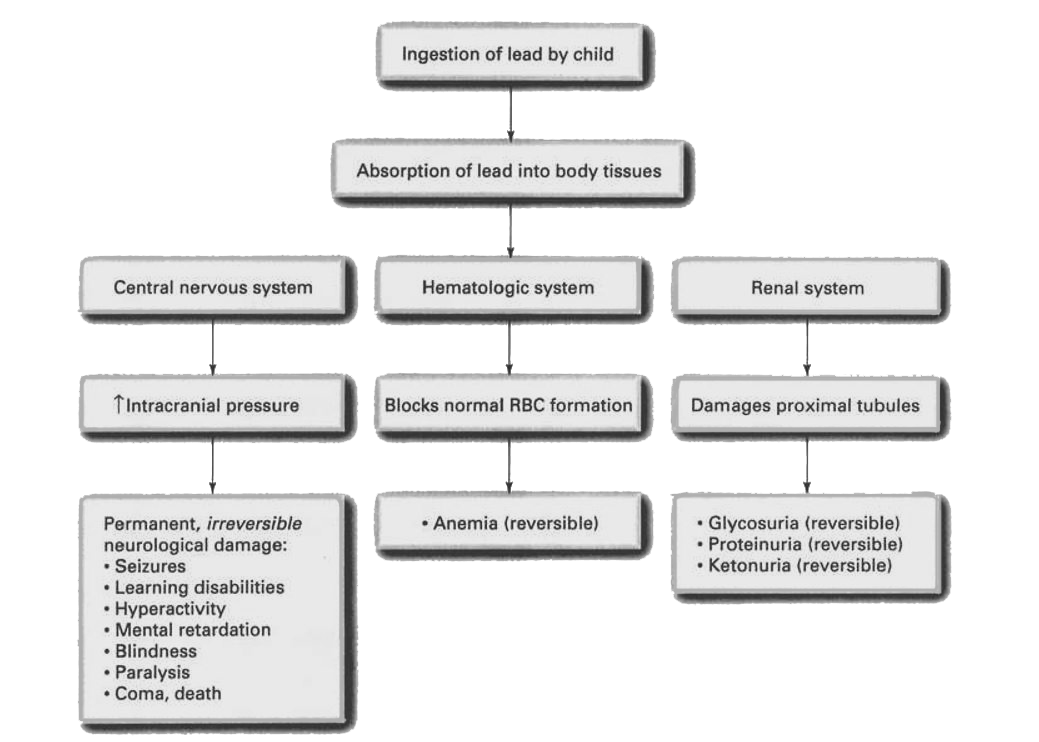
Introduction: Lead poisoning is a heavy-metal poisoning that occurs from ingestion or inhalation of lead. In children, this is most common in the toddler age group (1-3 yr) and is usually a chronic type of poisoning that occurs as the result of repeated ingestions of lead. Children who engage in the practice of pica, the ingestion of nonnutritive substances, often ingest lead in flecks of lead-based paint from walls, furniture, or toys. In addition, research demonstrates that the parent-child relationship is a significant variable in lead poisoning; typically, there is a lack of adequate parental supervision that enables the child to engage in pica repeatedly over a fairly long time, until symptoms of lead poisoning become evident. (Figure 5-13 shows the pathophysiological effects of lead poisoning.)
FIGURE 5-13 Pathophysiological effects of lead poisoning.
-
Assessment:
- Investigate history of pica (ingestion of nonnutritive substance).
- Evaluate parent-child relationship.
- Chronic lead poisoning: vague, crampy abdominal pain; constipation; anorexia and vomiting; listlessness.
- Neurological, renal, hematological effects: see Figure 5-13.
- “Blood-lead line”—bluish black line seen in gums.
- X-rays: lead lines in long bones and flecks of lead in GI tract.
- Elevated serum-blood-lead levels: ^20 pg/dL requires clinical management; ^45 pg/dL requires parenteral chelating therapy.
-
Analysis/nursing diagnosis:
- Altered thought processes related to neurotoxicity.
- Activity intolerance (and risk for infection) related to anemia.
- Altered urinary elimination related to excretion of lead by kidneys.
- Pain related to lead poisoning and its treatment.
- Knowledge deficit related to etiology of lead poisoning.
-
Nursing care plan/implementation:
-
Goal: promote excretion of lead.
- Administer chelating agents (EDTA [IM or IV], BAL (IM only]) as ordered. Chelation therapy typically continues over several days, with multiple treatments daily.
- Monitor kidney function carefully: the treatment itself is potentially nephrotoxic. Maintain adequate oral intake of fluids.
- Institute seizure precautions.
-
Goal: prevent reingestion of lead.
- Determine primary source of poisoning.
- Eliminate source from child’s environment before discharge.
-
Follow up with home care referral.
- Screen other siblings prn.
- Monitor “blood-lead level” of all children in the home.
-
Goal: assist child to cope with multiple painful injections when treated with IM chelation therapy.
- Prepare child for treatment regimen.
- Stress that this is not a punishment.
- Rotate sites as much as possible.
- May use a local anesthetic, e.g., procaine, injected simultaneously with chelating agent to decrease pain of injections.
- Apply warm soaks to injection sites: may help lessen pain.
- Encourage child to self-limit gross muscle activity (which increases pain).
- Offer child safe outlets for anger, fear, frustration—punching bag, pounding board, clay.
- Offer opportunity for medical play with empty syringes, etc.
-
Goal: health teaching.
- Stress (to child and parents) that removing the lead is the only way to prevent permanent, irreversible neurological damage (irreversible damage may have already occurred).
- Teach that the chelating agent binds with the lead and promotes its excretion through the kidneys.
-
Goal: promote excretion of lead.
-
Evaluation/outcome criteria:
- Lead is successfully removed from child’s body without permanent damage.
- No further episodes of lead poisoning.
- Child copes successfully with the disease and its treatment.