Pattern
Description
Nursing Intervention
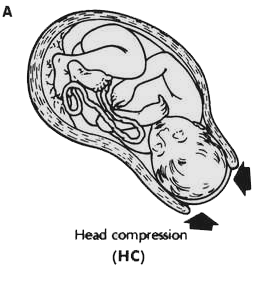
Early Decelerations
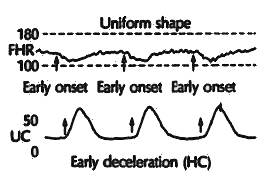
- FHR begins to slow with the onset of the uterine contraction (UC) and returns to baseline when contraction
- Fetol head compression occurs.
- Vagal nerve stimulation.
- Transient slowing of FHR.
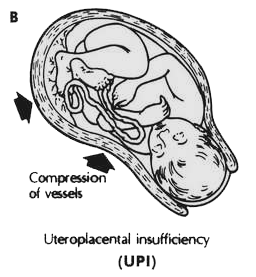
Late Decelerations
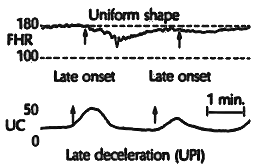
- FHR begins to fall at height of the UC and returns to baseline after contraction has ceased.
- FHR usually remains within normal
- Indicates some degree of uteroplacental insufficiency.
Change maternal position.
Turn off Pitocin; increase rate of maintenance IV.
Begin oxygen by face mask
Notify physician.
Check blood pressure and pulse rate.
Possible candidate for cesarean birth.
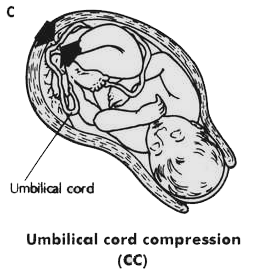
Variable Decelerations
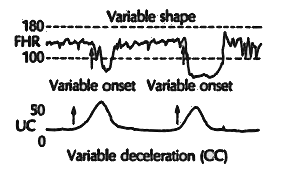
- Slowing of FHR either with a contraction or in between contractions. Unrelated pattern of FHR and uterine contraction.
- Pattern may be U shaped or V shaped. Transitory acceleration precedes or follows the deceleration.
- FHR may fall below 100 beats/min; then returns immediately to baseline.
- Usually indicates cord compression.
Change maternal position to alleviate cord pressure.
Turn off Pitocin; increase rate of maintenance IV.
Begin oxygen by face mask.
Notify physician.
Check blood pressure and pulse rate.
Possible candidate for cesarean birth.
Possible candidate for amnio infusion.