1. Responsibilities of the health agency
    1. Provide a neonatal intensive care unit (NICU) or transfer to another hospital.
    2. Personnel-adequate number trained in neonate diseases, special treatment, and equipment.
    3. Equipment-adequate supply on hand, functioning properly (especially temperature regulator in incubator, oxygen analyzer, blood-gas machine).
  2. Dying infants
    1. Decision regarding resuscitation in cardiac arrest, with brain damage from cerebral anoxia. It is difficult to predict the effect of anoxia in infancy on the child’s later life.
    2. Decision to continue supportive measures.
    3. Issue of euthanasia, such as in severe myelomeningocele at birth.
      1. Active euthanasia (giving overdose).
      2. Passive euthanasia (not placing on respirator).
  3. Extended role of nurse in NICU-may raise issues of nursing practice versus medical practice, as when a nurse draws blood samples for blood gas determinations without prior order. To be legally covered:
    1. The nurse must be trained to perform specialized functions.
    2. The functions must be written into the nurse’s job description.
  4. Issue of negligence-such as cross-contamination in nursery.
  5. Issue of malpractice-such as assigning care of critically ill infant on respirator to untrained student or aide.
    1. May be liable for inaccurate bilirubin studies for neonatal jaundice; may be legally responsible if brain damage occurs in absence of accurate laboratory tests.
    2. May be liable for brain damage in infant due to respiratory or cardiac distress. Nurse must make sure that there are frequent blood gas determinations to ensure adequate oxygen to prevent brain damage. Nurse also must make sure that the infant is not receiving too high a concentration of oxygen, which may lead to retrolental fibroplasia.
  1. Four sets of criteria to determine criminal responsibility at time of alleged offense
    1. M’Naghten Rule-a person is not guilty if:
      1. Person did not know the nature and quality of the act.
      2. Person could not distinguish right from wrong-if person did not know what he or she was doing, person did not know it was wrong.
    2. The Irresistible Impulse Test (used together with M’Naghten Rule)-person knows right from wrong, but:
      1. Driven by impulse to commit criminal acts regardless of consequences.
      2. Lacked premeditation in sudden violent behavior.
    3. American Law Institute's Model Penal Code (1955) Test
      1. Not responsible for criminal act if person lacks capacity to “appreciate” the wrongfulness of it or to “conform” conduct to requirements of law.
      2. Excludes “an abnormality manifested only by repeated criminal or antisocial conduct"- namely, psychopathology.
      3. Includes “knowledge” and “control” criteria.
    4. Durham Test (Product Rule-1954): accused not criminally responsible if act was a “product of mental disease.” Discarded in 1972.
  2. Types of admissions
    1. Voluntary: person, parent, or legal guardian applies for admission; person agrees to receive treatment and to follow hospital rules; civil rights are retained.
    2. Involuntary: process and criteria vary among states.


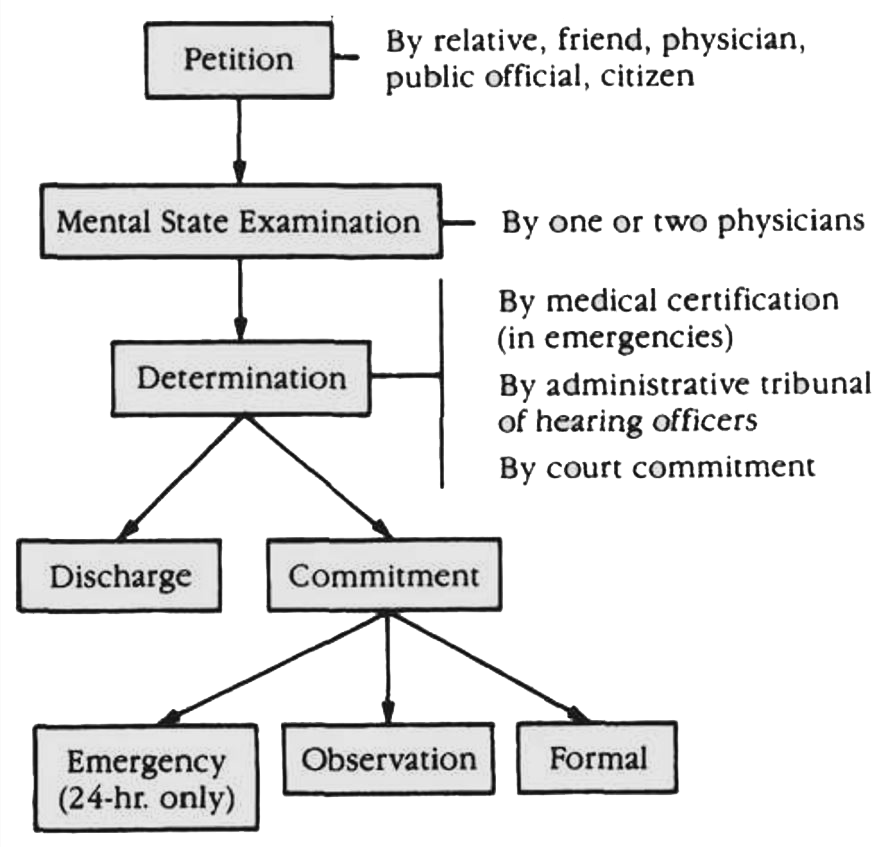
This diagram shows the process of the procedure for involuntary commitment. First is the petition, by relative, friend, physician, public official, citizen. And next is Mental state Examination, by one or two physicians. Next is the Determination, by medical certification (in emergencies). By administrative tribunal of hearing officers. By court commitment. After the Determination. It has Discharge and Commitment. The commitment has Emergency (24 hours only). Observation. Formal.

  1. Legal and civil rights of hospitalized patients - the right to:
    1. Wear own clothes, keep and use personal possessions and reasonable sum of money for small purchases.
    2. Have individual storage space for private use.
    3. See visitors daily.
    4. Have reasonable access to confidential phone conversations.
    5. Receive unopened correspondence and have access to stationery, stamps, and a mailbox.
    6. Refuse: shock treatments, lobotomy.

  2. Concepts central to community mental health (Community Mental Health Act, 1980)
    1. Systems perspective: scope of care moves beyond the individual to the community, with influences from biological, psychological, and sociocultural forces.
    2. Emphasis on prevention: primary (reduce incidents by preventing harmful social conditions); secondary (early identification and treatment of disorders to reduce duration); tertiary (early rehabilitation to reduce impairment from disorders).
    3. Interdisciplinary collaboration: flexible roles based on unique areas of expertise.
    4. Consumer participation and control.
    5. Comprehensive services: outpatient care, partial hospitalization, 24-hour hospitalization and emergency care; consultation and education; screening services.
    6. Continuity of care.
  1. No surgical procedure, however minor, can proceed without the voluntary, informed, and written consent of the patient.
    1. Surgical permits are witnessed by the physician, nurse, or other authorized person.
    2. Surgical permits protect the patient against unsanctioned surgery and also protect the surgeon and hospital staff against claims of unauthorized operations.
    3. Informed consent means that the operation has been fully explained to the patient, including possible complications and disfigurements, as well as whether any organ or parts of the body are to be removed.
    4. Adults and emancipated minors may sign their own operative permits if they are mentally competent; permission for surgery of minor children and incompetent or unconscious adults must be obtained from a responsible family member or guardian.
    5. The signed operative permit is placed in a prominent place on the patient’s chart and accompanies the patient to the operating room.
    6. Legal issues in the emergency room: record keeping plays an essential role in both the prevention and defense of malpractice suits. Detailed documentation not only provides for continuity of care but also perpetuates evidence that care was appropriately given. Records should:
      1. Be written legibly.
      2. Clearly note events and time of occurrence.
      3. Contain all lab slips and results of other tests.
      4. Describe events and patients objectively.
      5. Clearly note physician’s parting instructions to the patient.
      6. Be signed where appropriate, such as with doctor’s orders.
      7. Contain descriptions of every event that might lead to a lawsuit, such as fights, injuries, equipment failures.
    7. Consent - although there is no law requiring written consent before performing medical treatment, all elective procedures can only be performed if the patient has been fully informed and voluntarily consents to the procedure.
      1. If informed consent cannot be obtained because of the patient’s condition and immediate treatment is necessary to save life or safeguard health, the emergency rule can be applied. This rule implies consent. However, if time allows, it is advisable to obtain either oral or written informed consent from someone who has authority to act for the patient.
      2. Verbal consents should be recorded in detail, witnessed and signed by two individuals.
      3. Written or verbal consent can be given by alert, coherent, or otherwise competent adults, by parents, legal guardian, or person in loco parentis (one standing in for the parent with the parent’s rights, duties, and responsibilities) of minors or incompetent adults.
      4. If the minor is 14 year old or older, consent must be acquired from the minor as well as from the parent or legal guardian. Emancipated minors can consent for themselves.