|
/ /
|
/ /
|
/ /
|
/ /
|
/ 1
|
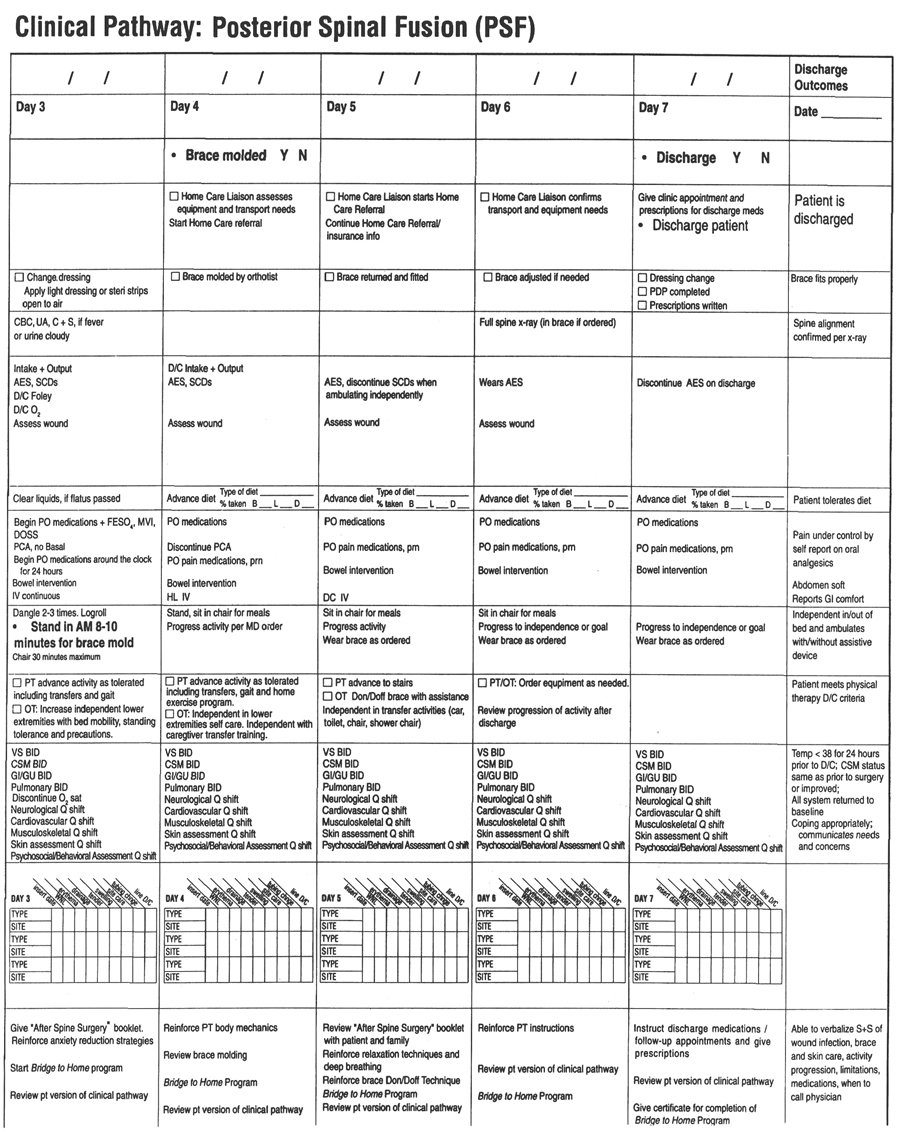
Discharge Outcomes
|
|
Day 3
|
Day 4
|
Day 5
|
Day 6
|
Day 7
|
Date
|
|
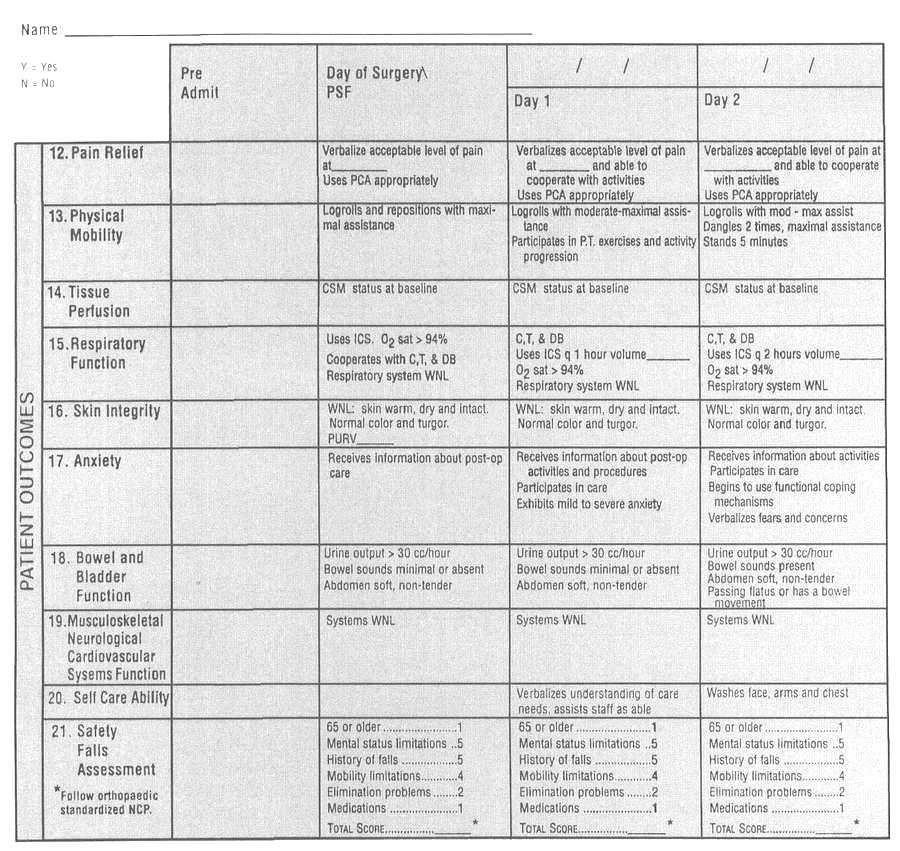
Verbalizes pain at acceptable level Uses PGA appropriately w/o basal + takes po pain medication around the clock
|
verbalizes patn at acceptable level; on PO pm pain medication
|
Pain at acceptable level with PO medication prn
|
Pain at acceptable level with PO medication pm
|
Pain 8t acceptable level with PO medication pm
|
Pain al acceptable level with PO medication prn
|
|
Lofitois, minimal-moderate assistance Dancies 2 times, moderate assistance Stands 8-10 minutes for brace mold
|
Gets intout of bed, moderate assistance Sits in chair (or meals 1-2 times Walks In room, moderale-maximal
|
Gets in/out of bod. minimal assistance Sits In chair 2-3 times
Walks to hall, moderate assistance 3x
Wearing brace as ordered
Reports need for adjustment of brace
|
Gets In/out ol bed
Sits in chair 2-3 times
Walks in hall minimal assistance times 3
|
Gets in/out of bed Independently Sits In chair 2-3 times Walks, Independently 3 times Reports brace correctly fitting
|
lodep-ndent in/out of bod
Walking on level and up/
doMtstiifS of reached goal
PafenWam-y demonstrate crVotf brace tethrioue
|
|
CSM status ai baselire
|
CSM status at baseline
|
CSM status al baseline
|
CSM status at baseline
|
CSM status at baseline
|
CSM status at baseline
|
|
C. T. 6 DB
Uses ICS q 2’ volume_______
O2 sat >94% on room air
Respiratory system WNL
|
Uses ICS Independently volume____
Respiratory system WNL
|
Uses ICS independently volume____
Respiratory system WNL
|
Uses ICS independently volume____
Respiratory system WNL
|
Respiratory system WNL
|
Respiratory system WNL
|
|
WNL skin warm, dry and Intact. Normal color and turgor PURV_
|
WNL skin warm, dry and Intact. Normal color and turgor.
|
WNL: skin warm, dry and intact. Normal color and turgor
|
WNL: skin warm, dry and Intact. Normal color and turgor.
PURV_____
|
WNL: skin warm, dry and Intact. Normal color and turgor.
|
Skin cleaa, de/, and tniacl; wound well-approximated without rednes&'swe'Lng
|
|
Receives and verbalizes understanding of information booklet
Participates In care
Anxiety reduction strategies
Able to group requests
Exhibits decreased anxiety
|
Verbalizes understanding of Information
Participates in care
Abie to use anxiety reduction strategies
|
Verbalizes understanding of information
Participates In care
Able to make decisions
|
Participates in care
Discusses plans lor going home
Makes decisions
|
Participates In care
Verbalizes ability to manage at home Makes decisions
|
Verbalizes ability to manage at home and/or with continuing care arrangements
|
|
Voiding without difficulty Bcwel sounds present Abdomen non-tender Passing flatus 01 has a bowel movement
|
Voiding without difficulty Bowel sounds present Abdomen non-tender Passing Hates. or na? a bowel movement
|
Voiding
Bowel sounds present
Abdomen ngn-tender
Passing flatus, or has a bowel movement
|
Voiding
Bowel sounds present
Abdomen non-tender
Passing flatus, and has a bowel movement
|
Voiding
Bowel sounds present
Abdomen non-tender
Passing flatus, or has a bowel movement
|
Voiding
Had BM during hospitalization
|
|
Systems WNL
|
Systems WNL
|
Systems WNL
|
Systems WNL
|
Systems WNL
|
Systems WNL
|
|
Washes areas m reach Feeds sell
|
Washes areas In reach
Feeds sett
|
Bathes sell with minimal assistance
|
Battves and toilets self with minimal assistance
|
Independent in self care or reaches goal
|
Indepemterii in sc ! ca:e or reaches goal
|
|
65 or older......................1
Mental status limitations........5
History ot fails.....................5
Mobility limitations.............4
Elimination problems...............2
Medications .....................1
Total Score.....................’
|
65 or Older... .................1
Mental states limitations .5
History of falls ...............5
Mobility limitations........ ...4
Elimination probterns...........2
Medications.....................1
Toial
Scene.............. *
|
65 or older........................1
Mental status limitations ..5
History of falls..................5
Mobility limitations..............4
Elimination problems..............2
Medications.......................1
Total Score.......................*
|
65 or older —......................1
Menial status limitations..........5
History of tails..................5
Mobility limitations..............4
Elimination problems..............2
Medications.......................1
Total Score....................... *
|
65 or older.......................1
Mental status limitations.........5
History of (alls..................5
Mobility limitations..............4
Elimination problems..............2
Medications.......................1
Total Score....................... *
|
No falls
|