THIS SHOULD BE DELETED!

          1. Femoral or subclavian vein access is immediate.
          2. May be short- or long-term duration.
      1. Complications during hemodialysis:
        1. Dysequilibrium syndrome - rapid removal of urea from blood —> reverse osmosis, with water moving into brain cells —» cerebral edema —> possible headache, nausea, vomiting, confusion, and convulsions; usually occurs with initial dialysis treatments; shorter dialysis time and slower rate minimizes.
        2. Hypotension - results from excessive ultrafiltration or excessive antihypertensive medications.
        3. Hypertension - results from volume overload (water and/or sodium), causing dysequilibrium syndrome or anxiety.
        4. Transfusion reactions.
        5. Arrhythmias -due to hypotension, fluid overload, or rapid removal of potassium.
        6. Psychologicalproblems:
          1. Patients react in varying ways to dependence on hemodialysis.
          2. Nurse needs to identify patient reactions and defense mechanisms and to

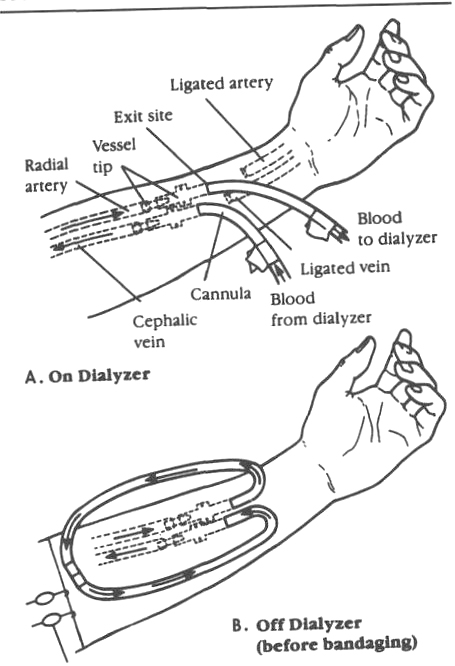
FIGURE 7-12 AV shunt (cannulae).


    Cannula clamps
      employ supportive behaviors, e.g., include patient in care; continual repetition and reinforcement; do not interpret patient’s behavior—for example, do not say, “You’re being hostile” or “You’re acting like a child”; answer questions honestly regarding quality and length of life with dialysis and/or transplantation; encourage independence as much as possible.
  1. Intermittent peritoneal dialysis: involves introduction of a dialysate solution into the abdomen, where the peritoneum acts as the semipermeable membrane between the solution and blood in abdominal vessels. Procedure:
    1. Area around umbilicus is prepared and anesthetized with local anesthetic, and a catheter is inserted into the peritoneal cavity through a trocar; the catheter is then sutured into place to prevent displacement.
    2. Warmed dialysate is then allowed to flow into the peritoneal cavity. Inflow time: 5-10 min; , Mg!t, K+, Cl', and lactate or acetate.
    3. When solution bottle is empty, dwell time (exchange time) begins. Dwell time: 10-20 min; processes of diffusion, osmosis, and filtration begin to move waste products from bloodstream into peritoneal cavity.
    4. Draining of the dialysate begins with the unclamping of the outflow clamp. Outflow time: usually 10 min; returns less than 2 liters usually result from incomplete peritoneal emptying; turn side to side to increase return; multiple exchanges in 24 hr depending on patient need.
  2. Continuous ambulatory peritoneal dialysis (CAPD): functions on the same principles as peritoneal dialysis, yet allows greater freedom and independence for dialysis patients. Procedure:

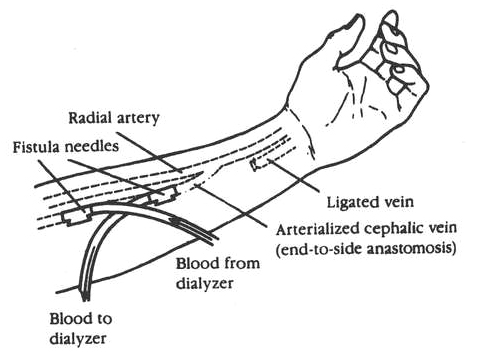
FIGURE 7-13 AV fistula.