1. Dialysis: diffusion of solute through a semipermeable membrane that separates two solutions; direction of diffusion depends on concentration of solute in each solution; rate and efficiency depend on concentration gradient, temperature of solution, pore size of membrane, and molecular size; two methods available.
    1. Indications: acute poisonings; acute or chronic renal failure; hepatic coma; metabolic acidosis; extensive burns with azotemia.
    2. Goals:
      1. Reduce level of nitrogenous waste.
      2. Correct acidosis, reverse electrolyte imbalances, remove excess fluid.
    3. Hemodialysis: circulation of patient’s blood through a compartment formed of a semipermeable membrane (polysulfone, polyacrylonitrile) surrounded by dialysate fluid.
      1. Types of venous access for hemodialysis:
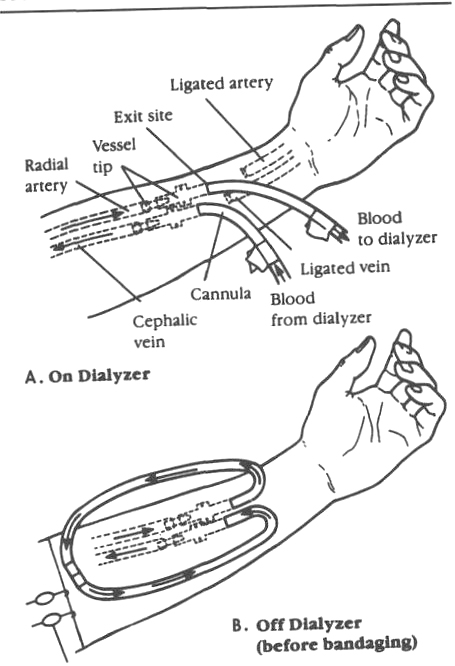
        1. External shunt.
          1. Cannula is placed in a large vein and a large artery that approximate each other.
          2. External shunts, which provide easy and painless access to bloodstream, are prone to infection and clotting and cause erosion of the skin around the insertion area.
            1. Daily cleansing and application of a sterile dressing.
            2. Prevention of physical trauma and avoidance of some activities, such as swimming.
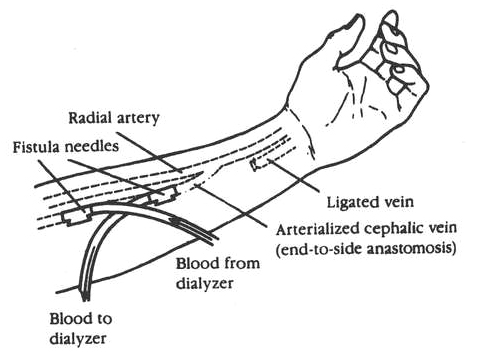
        2. Arteriovenous fistulas or graft.
          1. Large artery and vein are sewn together (anastomosed) below the surface of the skin (fistula) or subcutaneous graft using the saphenous vein, synthetic prosthesis, or bovine xenograft to connect artery and vein.
          2. Purpose is to create one blood vessel for withdrawing and returning blood.
          3. Advantages: greater activity range than AV shunt and no protective asepsis.
          4. Disadvantage: necessity of two venipunctures with each dialysis.
        3. Vein catheterization.
          1. Femoral or subclavian vein access is immediate.
          2. May be short- or long-term duration.
      2. Complications during hemodialysis:
        1. Dysequilibrium syndrome - rapid removal of urea from blood —> reverse osmosis, with water moving into brain cells —» cerebral edema —> possible headache, nausea, vomiting, confusion, and convulsions; usually occurs with initial dialysis treatments; shorter dialysis time and slower rate minimizes.
        2. Hypotension - results from excessive ultrafiltration or excessive antihypertensive medications.
        3. Hypertension - results from volume overload (water and/or sodium), causing dysequilibrium syndrome or anxiety.
        4. Transfusion reactions.
        5. Arrhythmias -due to hypotension, fluid overload, or rapid removal of potassium.
        6. Psychologicalproblems:
          1. Patients react in varying ways to dependence on hemodialysis.
          2. Nurse needs to identify patient reactions and defense mechanisms and to employ supportive behaviors, e.g., include patient in care; continual repetition and reinforcement; do not interpret patient’s behavior—for example, do not say, “You’re being hostile” or “You’re acting like a child”; answer questions honestly regarding quality and length of life with dialysis and/or transplantation; encourage independence as much as possible.
    4. Intermittent peritoneal dialysis: involves introduction of a dialysate solution into the abdomen, where the peritoneum acts as the semipermeable membrane between the solution and blood in abdominal vessels. Procedure:
      1. Area around umbilicus is prepared and anesthetized with local anesthetic, and a catheter is inserted into the peritoneal cavity through a trocar; the catheter is then sutured into place to prevent displacement.
      2. Warmed dialysate is then allowed to flow into the peritoneal cavity. Inflow time: 5-10 min; , Mg!t, K+, Cl', and lactate or acetate.
      3. When solution bottle is empty, dwell time (exchange time) begins. Dwell time: 10-20 min; processes of diffusion, osmosis, and filtration begin to move waste products from bloodstream into peritoneal cavity.
      4. Draining of the dialysate begins with the unclamping of the outflow clamp. Outflow time: usually 10 min; returns less than 2 liters usually result from incomplete peritoneal emptying; turn side to side to increase return; multiple exchanges in 24 hr depending on patient need.
    5. Continuous ambulatory peritoneal dialysis (CAPD): functions on the same principles as peritoneal dialysis, yet allows greater freedom and independence for dialysis patients. Procedure:
      1. Dialysis solution is infused into peritoneum three times daily and once before bedtime.
      2. Dwell time - 24 hour for each daily exchange, and overnight for the fourth (8-12 hours).
      3. Indwelling peritoneal catheter is connected to solution bag at all times - serves to fill and drain peritoneum; concealed in cloth pouch, strapped to the body during dwell time; patient can move about doing usual activities.
    6. Continuous cycling peritoneal dialysis: same principles as CAPD, except uses an automated system to infuse and remove dialysate; reduces nursing care needs with hospitalized patients. Cumbersome equipment inhibits nighttime mobility. Procedure:
      1. Long exchanges without an automated cycler during the day and short exchanges with a cycler at night.
      2. Dwell time - 6-8 hr while sleeping.
      3. Automatic alarms to prevent malfunction with home use.

FIGURE 7-12 AV shunt (cannulae).


FIGURE 7-13 AV fistula.


TABLE 7-30 Comparison of Hemodialysis and Peritoneal Dialysis


Hemodialysis Peritoneal Dialysis
Process Rapid uses either external AV shunt (acute renal failure) or internal AV fistula (chronic renal failure); typical treatment is 3-4 hours, 3 days/week; also used for barbiturate overdoses to remove toxic agent quickly. Intermittent - up to 36 hours for hospitalized patients; outpatients 4-8 hours, 5-6 times per week; dwell time 30-45 minutes for manual dialysis or 10-20 minutes for automatic cycler; either rigid stylet catheter orsurgically inserted soft catheter; advantage for patients who cannot tolerate rapid fluid and electrolyte changes.
Continuous - two methods: (1) four cycles in 24 hours; dwell time is 4-5 hours during the day and 8-12 hours overnight; no need for machinery, electricity, or water source; surgically inserted soft catherter; closely resembles normal renal function; (2) automated cycler infuses and removes dialysate; generally done while patient sleeps; built-in alarms for patient safety.
Vascular access Required Not necessary; therefore suitable for patients with vascular problems
Heparinization Required; systemic or regional Little or no heparin necessary; therefore suitable for patients with bleeding problems
Complications (other than fluid and elctrolyte imbalances, which are common to all) Dialysis dysequilibrium syndrome (preventable)
Mechanical dysfunctions of dialyzer
Peritonitis
Hypoalbuminemia
Bowel or bladder perforation
Plugged or dislodged catheter