Crisis Intervention
Crisis intervention is a type of brief psychiatric treatment in which individuals or their families are helped in their efforts to forestall the process of mental decompensation in reaction to severe emotional stress by direct and immediate supportive approaches.
-
Definition of crisis: sudden event in one’s life that disturbs homeostasis, during which usual coping mechanisms cannot resolve the problem. Types of crisis:
-
Maturational: see Erik Erikson’s eight stages of developmental crises anticipated in the development of the infant, child, adolescent, and adult.
-
Situational: occurs at any time, e.g., loss of job, loss of income, death of significant person, illness, hospitalization.
-
Concepts and principles related to crisis intervention:
-
Crises are turning points where changes in behavior patterns and lifestyles can occur; individuals in crisis are most amenable to altering old and unsuccessful coping mechanisms and are most likely to learn new and more functional behaviors.
-
Social milieu and its structure are contributing factors in both the development of psychiatric symptoms and eventual recovery from them.
-
If crisis is handled effectively, the person’s mental stability will be maintained; individual may return to a precrisis state or better.
-
If crisis is not handled effectively, individual may progress to a worse state with exacerbations of earlier conflicts; future crises may not be handled well.
-
There are a number of universal developmental crisis periods (maturational crises) in every individual’s life.
-
Each person tries to maintain equilibrium through use of adaptive behaviors.
-
When individuals face a problem they cannot solve, tension, anxiety, narrowed perception, and disorganized functioning occur.
-
Immediate relief of symptoms produced by crisis is more urgent than exploring their cause.
-
Characteristics of crisis intervention:
-
Acute, sudden onset related to a stressful precipitating event of which individual is aware but which immobilizes previous coping abilities.
-
Responsive to brief therapy with focus on immediate problem.
-
Focus shifted from the psyche in the individual to the individual in the environment; deemphasis on intrapsychic aspects.
-
Crisis period is time limited (usually up to 6 weeks).
-
Nursing care plan/implementation in crises:
-
General goals:
-
Avoid hospitalization if possible.
-
Return to precrisis level and preserve ability to function.
-
Assist in problem solving, with here-and-now focus.
-
Assess the crisis:
-
Identify stressful precipitating events: duration, problems created, and degree of significance.
-
Assess suicidal and homicidal risk.
-
Assess amount of disruption in individual’s life and effect on significant others.
-
Assess current coping skills, strengths, and general level of functioning.
-
Plan the intervention:
-
Consider past coping mechanisms.
-
Propose alternatives and untried coping methods.
-
Implementation:
-
Help client relate the crisis event to current feelings.
-
Encourage expression of all feelings related to disruption.
-
Explore past coping skills and reinforce adaptive ones.
-
Use all means available in social network to take care of client’s immediate needs (e.g., significant others, law enforcement agencies, housing, welfare, employment, medical, and school).
-
Set limits.
-
Health teaching: teach additional problemsolving approaches.
-
Evaluation/outcome criteria:
-
Client returns to precrisis level of functioning.
-
Client learns new, more effective coping skills.
-
Client can describe realistic plans for future in terms of own perception of progress, support system, and coping mechanisms.
Selected Specific Crisis Situations: Problems Related to Abuse
-
Domestic Violence: Battered Woman
-
Characteristics
-
Victims:
feel helpless, powerless to prevent assault; blame themselves; ambivalent about leaving the relationship.
-
Abusers:
often blame the victims; have poor impulse control; use power (physical strength or weapon) to threaten and subject victims to their assault.
-
Cycle of
stages, with increase in severity of the battering:
-
Buildup of tension
(through verbal abuse): abuser is often drinking or taking other drugs; victim blames self.
-
Battering:
abuser does not remember brutal beating; victim is in shock and detached.
-
Calm:
abuser “makes up,” apologizes, and promises “never again”; victim believes and forgives the abuser, and feels loved.
-
Risk factors
-
Learned responses:
abuser and victim have had past experience with violence in family; victim has “learned helplessness.”
-
Pregnant
women and those with one or more
preschool children,
who see no alternative to staying in the battering relationship.
-
Women who
fear
punishment from the abuser.
-
Assessment:
-
Injury to parts of body, especially face, head, genitals (e.g., welts, bruises, fracture of nose).
-
Presents in the emergency department with report of “accidental injury.”
-
Severe anxiety.
-
Depression.
-
Analysis/nursing diagnosis:
-
Risk for injury
related to physical harm.
-
Posttraumatic response
related to assault.
-
Fear
related to threat of death or change in health status.
-
Pain
related to physical and psychological harm.
-
Powerlessness
related to interpersonal interaction.
-
Ineffective individual coping
related to situational crisis.
-
Spiritual distress
related to intense suffering and challenged value system.
-
Nursing care plan/implementation:
-
Provide safe environment; refer to community resources for shelter.
-
Treat physical injuries.
-
Document injuries
-
Supportive, nonjudgmental approach: identify woman’s strengths; help her to accept that she cannot control the abuser; encourage description of home situation; help her to see choices.
-
Encourage individual and family therapy for victim and abuser.
-
Evaluation/outcome criteria:
-
Physical symptoms have been treated.
-
Discusses plans for safety (for self and any children) to protect against further injury.
-
Rape-trauma Syndrome
-
Definition: forcible perpetration of an act of sexual intercourse on the body of an unwilling person.
-
Assessment:
-
Signs of physical trauma -
physical findings of entry.
-
Symptoms of physical trauma
- verbatim statements regarding type of sexual attack.
-
Signs of emotional trauma -
tears, hyperventilation, extreme anxiety, withdrawal, selfblame, anger, embarrassment, fears, sleeping and eating disturbances, desire for revenge.
-
Symptoms of emotional trauma
- statements regarding method of force used and threats made.
-
Analysis/nursing diagnosis:
rape-trauma syndrome
related to phases of response to rape:
-
Acute response:
volatility, disorganization, disbelief, shock, incoherence, agitated motor activity, nightmares, guilt (should have been able to protect self), phobias (crowds, being alone, sex).
-
Outward coping:
denial and suppression of anxiety and fear (silent rape syndrome), feelings appear controlled.
-
Integration and resolution:
confronts anger with attacker; realistic perspective.
-
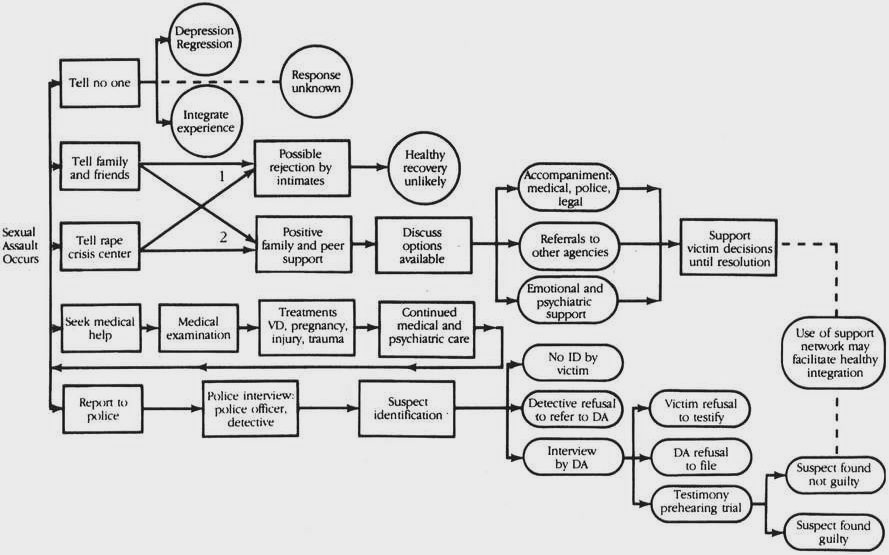
Nursing care plan/implementation in counseling rape victims. Figure below is a summary of self-care decisions a victim faces the first night following a sexual assault.
-
Overall goals:
-
Acknowledge feelings.
-
Face feelings.
-
Resolve feelings.
-
Maintain and restore
self-respect, dignity, integrity,
and
self-determination.
-
Work through issues:
-
Handle
legal matters and police contacts
-
b. Clarify facts.
-
Get
medical
attention if needed.
-
Notify
family and friends.
-
Understand emotional reaction.
-
Attend to
practical
concerns.
-
Evaluate need for psychiatric consultations.
-
Acute phase:
-
Decrease victim’s stress, anxiety, fear.
-
Seek medical care.
-
Increase self-confidence and self-esteem.
-
Identify and accept feelings and needs (to be in control, cared about, to achieve).
-
Reorient perceptions, feelings, and statements about self.
-
Help resume normal lifestyle.
-
Outward coping phase:
-
Remain available and supportive.
-
Reflect words, feelings, and thoughts.
-
Explore real problems.
-
Explore alternatives regarding contraception, legal issues.
-
Evaluate response of family and friends to victim and rape.
-
Integration and resolution phase:
-
Assist exploration of feelings (anger) regarding attacker.
-
Explore feelings (guilt and shame) regarding self.
-
Assist in making own decisions regarding health care.
-
Maintain confidentiality and neutrality - facilitate person’s own decision.
-
Search for alternatives to giving advice.
-
Health teaching:
-
Explain procedures and services to victim.
-
Counsel to avoid isolated areas and being helpful to strangers.
-
Counsel where and how to resist attack (scream, run unless assailant has weapon).
-
Teach what to do if pregnancy or STD is outcome.
|
Victim decisions following a sexual assault. (From the Rape Crisis Services of the YWCA, Greater Harrisburg, Pa.)
|
|
-
Evaluation/outcome criteria: little or no evidence of possible long-term effects of rape (guilt, shame, phobias, denial).
-
Battered Child
-
Assessment - clues to the identification of a battered child*
-
Clues in the
history
-
Significant
delay
in seeking medical care.
-
Major
discrepancies
in the history:
-
Discrepancy between different people’s versions of the story.
-
Discrepancy between the history and the observed injuries.
-
Discrepancy between the history and the child’s developmental capabilities.
-
History of multiple emergency department visits for various injuries.
-
A story that is
vague
and
contradictory.
-
Clues in the
physical examination
-
Child who seems withdrawn, apathetic, and
does not cry
despite his or her injuries.
-
Child who
does not turn to parents for comfort;
or unusual desire to please parent; unusual fear of parent(s).
-
Child who is poorly nourished
and
poorly cared for.
-
The presence of
bruises: multiple bruises,
welts, and abrasions, especially around the trunk and buttocks;
old bruises in addition to fresh ones
.
-
The presence of
suspicious burns:
-
Cigarette burns.
-
Scalds without splash marks or involving the buttocks, hands, or feet but sparing skinfolds.
-
Rope marks.
-
Clues in parent behavior - exaggerate care and concern.
-
Analysis/nursing diagnosis:
-
Same as for battered woman.
-
Altered parenting
related to poor role model/identity, unrealistic expectations, presence of stressors and lack of support.
-
Low self-esteem
related to deprivation and negative feedback.
-
Nursing care plan/implementation:
-
Same as for battered woman.
-
Report suspected child abuse to appropriate source.
-
Conduct assessment interview in private, with child and parent separated.
-
Be supportive and nonjudgmental.
-
Evaluation/outcome criteria:
-
Same as battered woman.
-
Child safety has been ensured.
-
Parent(s) or caregivers have agreed to seek help.
-
Sexual Abuse of Children
-
Assessment - characteristic behaviors:
-
Relationship
of offender to victim: many filling paternal role (uncle, grandfather, cousin) with repeated, unquestioned access to the child.
-
Methods of
pressuring
victim into sexual activity: offering material goods, misrepresenting moral standards (“it’s OK”), exploiting need for human contact and warmth.
-
Method of pressuring victim to
secrecy
(to conceal the act) is inducing fear of punishment, not being believed, rejection, being blamed for the activity, abandonment.
-
Disclosure of sexual activity via:
-
Direct visual or verbal confrontation and
observation
by others.
-
Verbalization
of act by victim.
-
Visible clues:
excess money and candy, new clothes, pictures, notes.
-
Signs and symptoms:
bed-wetting, excessive bathing, tears, avoiding school, somatic distress
(GI and urinary
tract pains).
-
Overly solicitous parental attitude toward child.
-
Analysis/nursing diagnosis:
-
Altered protection
related to inflicted pain.
-
Risk for injury
related to neglect, abuse.
-
Personal identity disturbance
related to abuse as child and feeling guilty and responsible for being a victim.
-
Ineffective individual coping
related to high stress level.
-
Sleep pattern disturbance
related to traumatic sexual experiences.
-
Ineffective family coping.
-
Altered family processes
related to use of violence.
-
Altered parenting
related to violence.
-
Powerlessness
related to feelings of being dependent on abuser.
-
Social isolation/withdrawal
related to shame about family violence.
-
Risk for altered abuse response patterns.
-
Nursing care plan/implementation:
-
Establish safe environment and the termination of trauma.
-
Encourage child to verbalize feelings about incident to dispel tension built up by secrecy.
-
Ask child to draw a picture or use dolls and toys to show what happened.
-
Observe for symptoms over a period of time.
-
Phobic
reactions when seeing or hearing offender’s name.
-
Sleep pattern
changes, recurrent dreams, nightmares.
-
Look for
silent reaction
to being an accessory to sex (i.e., child keeping burden of the secret activity within self); help deal with unresolved issues.
-
Establish therapeutic alliance with abusive parent.
-
Health teaching:
-
Teach child that his (her) body is private and to inform a responsible adult when someone violates privacy without consent.
-
Teach adults in family to respond to victim with sensitivity, support, and concern.
-
Evaluation/outcome criteria:
-
Child’s needs for affection, attention, personal recognition, or love met without sexual exploitation.
-
Perpetrator accepts therapy.
-
Conspiracy of silence is broken.
Estimation of Time at Which Soft Tissue Injury Occurred
| Injury Occurred |
Color |
|
0-2 hrs
|
No discoloration (may have edema and pain)
|
| 1-5 days |
Red/blue
|
| 5-7 days |
Green
|
| 7-10 days |
Yellow
|
| 10-14 days |
Brown
|
-
Elder Abuse/Neglect
-
Definition: battering, psychological abuse, sexual assault, or any act or omission by personal caregiver, family, or legal guardian that results in harm or threatened harm.
-
Concepts, principles, and characteristics:
-
Elders who are currently being abused often abused their abusers—their offspring. Violence is a learned behavior.
-
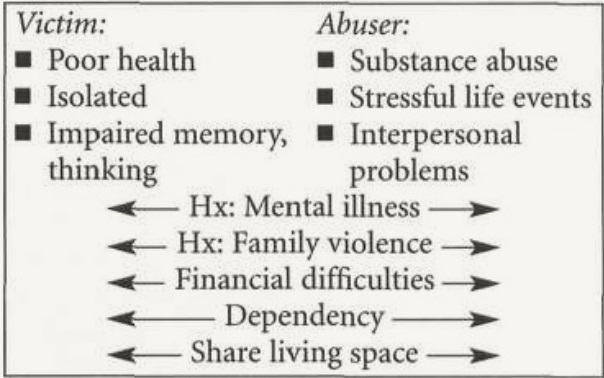
Victim characteristics: diminished self-esteem, feeling responsibility for the abuse, isolated.
-
Abuser characteristics: usually has physical or psychosocial stressors related to marital or fiscal difficulties; substance abuse.
-
Legal: most states have mandatory laws to report elder abuse, although many cases are not reported because of shame, fear of more abuse, cultural/religious beliefs, optimism, loyalty, financial dependency.
-
Types of abuse:
-
Financial abuse, e.g., fraudulent monetary schemes, theft (money, property, or both).
-
Neglect, e.g., lack of food, clean clothing, medications; no provision for assistive devices (dentures, hearing aids, glasses, canes).
-
Psychological abuse, e.g., verbal abuse.
-
Physical abuse, e.g., beating, physical restraints, rape.
-
Assessment:
-
Risk factors:
-
Behavioral clues: agitation, anger, denial, fear, confusion, depression, withdrawal, unbelievable stories about causes of injuries.
-
Physical indicators: weight loss; unexplained cuts, bruises, puncture wounds; untreated injuries; unkempt; noncompliance with medical plan of care.
-
Financial matters: e.g., recent changes in will; unusual banking activity; missing checks, personal belongings; forged signatures; unwillingness to spend money on the elder.
-
Analysis/nursing diagnosis:
-
Risk for injury related to neglect, abuse.
-
Fear.
-
Powerlessness related to dependency on abuser.
-
Unilateral neglect.
-
Spiritual distress.
-
Altered family processes related to use of violence.
-
Nursing care plan/implementation:
-
Primary prevention:
-
Early case finding; early treatment.
-
Referral to community services for caregiver (e.g., respite care) before serious abuse occurs.
-
Secondary prevention:
-
Report case to law enforcement agencies.
-
Provide elder with phone number for confidential hotline.
-
Plan for safety of elder (e.g., shelter).
-
Tertiary prevention:
-
Counseling, support, and self-help groups for victim.
-
Legal action against abuser.
-
Evaluation/outcome criteria:
-
Elder develops trust in caregivers, without fear of further abuse.
-
Spiritual well-being is enhanced, with diminished feelings of guilt, hopelessness, and powerlessness.