PROTECTIVE FUNCTIONS
Common Behavioral Problems
-
Anger
-
Definition: feelings of resentment in response to anxiety when threat is perceived; need to discharge tension of anger.
-
Assessment:
-
Degree of anger and frequency: scope of anger ranges on a continuum from everyday mild annoyance —> frustration from interference with goal accomplishment —> assertiveness (behavior used to deal with anger effectively) —> anger related to helplessness and powerlessness that may interfere with functioning —> rage and fury, when coping means are depleted or not developed.
-
Mode of expression of anger
-
Covert, passive expression of anger: being overly nice; body language with little or no eye contact, arms close to body, soft voice, little gesturing; sarcasm through humor; sublimation through art and music; projection onto others; denying and pushing anger out of awareness; psychosomatic illness in response to internalized anger, e.g., headache.
-
Overt, active expression of anger: physical activity to work off excess physical energy associated with biological response (e.g., hitting a punching bag, taking a walk); aggression, assertiveness.
-
Physiological behaviors - result of secretion of epinephrine and sympathetic nervous system stimulation preparing for fight-flight.
-
Cardiovascular response: increased blood pressure and pulse, increased free fatty acid in blood.
-
Gastrointestinal response: increased nausea, salivation, decreased peristalsis.
-
Genitourinary response: urinary frequency.
-
Neuromuscular response: increased alertness, increased muscle tension and deeptendon reflexes, ECG changes.
-
Positive functions of anger
-
Energizes behavior.
-
Protects positive image.
-
Provides ego defense during high anxiety.
-
Gives greater control over situation.
-
Alerts to need for coping.
-
A sign of a healthy relationship.
-
Analysis/nursing diagnosis: defensive coping related to source of stress (stressors):
-
Biological stressors - instinctual drives (Lorenz, on aggressive instincts, and Freud), endocrine imbalances, seizures, tumors, hunger, fatigue.
-
Psychological stressors - inability to resolve frustration that leads to aggression; real or imagined threatened loss of self-esteem; conflict, lack of control; anger as a learned expression and a reinforced response. Prolonged stress; an attempt to protect self; a desire for retaliation; a normal part of grief process.
-
Sociocultural stressors - lack of early training in self-discipline and social skills; crowding, personal space intrusion; role modeling of abusive behavior by significant others and by media personalities.
-
Nursing care plan/implementation long-term goals: constructive use of angry energy to accomplish tasks and motivate growth.
-
Prevent and control violence.
-
Approach unhurriedly.
-
Provide atmosphere of acceptance; listen attentively, refrain from arguing and criticizing.
-
Encourage expression of feelings.
-
Offer feedback of client’s expressed feelings.
-
Encourage mutual problem solving.
-
Encourage realistic perception of others and situation and respect for the rights of others.
-
Limit setting:
-
Clearly state expectations and consequences of acts.
-
Enforce consequences.
-
Encourage client to assume responsibility for behavior.
-
Explore reasons and meaning of negative behavior.
-
Promote self-awareness and problem-solvmg abilities. Encourage and assist client to:
-
Accept self as a person with a right to experience angry feelings.
-
Explore reasons for anger.
-
Describe situations where anger was experienced.
-
Discuss appropriate alternatives for expressing anger (including assertiveness training).
-
Decide on one feasible solution.
-
Act on solution.
-
Evaluate effectiveness.
-
Health teaching:
-
Explore other ways to express feelings, and provide activities that allow appropriate expression of anger.
-
Recommend that behavioral limits be set (by the family).
-
Explain how to set behavioral limits.
-
Advise against causing defensive patterns in others.
-
Evaluation/outcome criteria:
-
Demonstrates insight (awareness of factors that precipitate anger; identifies disturbing topics, events, and inappropriate use of coping mechanisms).
-
Uses appropriate coping mechanisms.
-
Reaches out for emotional support before stress level becomes excessive.
-
Evidence of increased reality perception and problem-solving ability.
-
Combative-aggressive behavior
-
Definition:acting out feelings of frustration, anger, anxiety, etc. through physical or verbal behavior.
-
Assessment: recognize precombative behavior:
-
Demanding, fist clenching.
-
Boisterous, loud.
-
Vulgar, profane.
-
Limited attention span.
-
Sarcastic, taunting, verbal threats.
-
Restless, agitated, elated.
-
Frowning.
-
Analysis/nursing diagnosis: risk for self-injury and violence directed at others related to:
-
Frustration as response to breakdown of selfcontrol coping mechanisms.
-
Acting out as customary response to anger (defensive coping).
-
Confusion (sensory/perceptual alterations).
-
Physical restraints, such as when postoperative patient discovers wrist restraints.
-
Fear of intimacy, intrusion on emotional and physical space (altered thought processes).
-
Feelings of helplessness, inadequacy (situational or chronic low self-esteem).
-
Nursing care plan/implementation:
-
Long-term goal: channel aggression - help person express feelings rather than act them out.
-
Immediate goal: prevent injury to self and others.
-
Calmly call for assistance; do not try to handle alone.
-
Approach cautiously. Keep client within eye contact, observing client’s personal space.
-
Protect against self-injury and injury to others; be aware of your position in relation to the weapon, door, escape route.
-
Minimize stimuli, to control the environment - clear the area, close doors, turn off TV so person can hear you.
-
Divert attention from the act; engage in talk and lead away from others.
-
Assess triggering cause.
-
Identify immediate problem.
-
Focus on remedy for immediate problem.
-
Choose one calm, quieting individual to interact with person; nonauthoritarian, nonthreatening.
-
Maintain verbal contact to keep communication open; offer empathetic ear, but be firm and consistent in setting limits on dangerous behavior.
-
Negotiate, but do not make false promises or argue.
-
Restraints may be necessary as a last resort.
-
Place person in quiet room so he or she can calm down.
-
Health teaching:
-
Explain how to obtain release from stress and how to rechannel emotional energy into acceptable activity.
-
Advise against causing defensive responses in others.
-
Explain what is justifiable aggression.
-
Emphasize importance of how to recognize tension in self.
-
Explain why self-control is important.
-
Explain to family, staff, how to set behavioral limits.
-
Explain causes of maladaptive coping related to anger.
-
Teach how to use problem-solving method.
-
Evaluation/outcome criteria:
-
Is aware of causes of anger; can recognize the feeling of anger and use alternative methods of expressing anger.
-
Expression of anger is appropriate, congruent with the situation.
-
Replaces aggression and acting out with assertiveness.
-
Confusion/disorientation
-
Definition: loss of reality orientation as to person, time, place, events, ideas.
-
Assessment: note unusual behavior:
-
Picking, stroking movements in the air or on clothing and linens.
-
Frequent crying or laughing.
-
Alternating periods of confusion and lucidity (e.g., confused at night, when alone in the dark).
-
Fluctuating mood, actions, rationality (argumentative, combative, withdrawn).
-
Increasingly restless, fearful, leading to insomnia, nightmares.
-
Acts bewildered; has trouble identifying familiar people.
-
Preoccupied; irritable when interrupted.
-
Unresponsive to questions; problem with concentration and setting realistic priorities.
-
Sensitive to noise and light.
-
Has unrealistic perception of time, place, and situation.
-
Nurse no longer seen as supportive but as threatening.
-
Analysis/nursing diagnosis: Altered thought processes and sensory/perceptual alterations related to:
-
Physical and physiological disturbances - metabolic (uremia, diabetes, hepatic dysfunction), fluid and electrolyte imbalances, cardiac arrhythmias, heart failure; anemia, massive blood loss with low hemoglobin; brain lesions; nutritional deficiency; pain; sleep disturbance; drugs (antidepressants, tranquilizers, sedatives, antihypertensives, diuretics, alcohol, PCP, street drugs).
-
Unfamiliar environment - unfamiliar routine and people; procedures that threaten body image; noisy equipment.
-
Loss of sensory acuity from partial or incomplete reception of orienting stimuli or information.
-
Disability in screening out irrelevant and excessive sensory input.
-
Memory impairment.
-
Nursing care plan/implementation:
-
Check physical signs, e.g., vital signs, neuro y logical status, fluid and electrolyte balance, and blood urea nitrogen.
-
Be calm; make contact to reorient to reality:
-
Avoid startling if person is alone, in the dark, sedated.
-
Make sure person can see, hear, and talk to you - turn off TV; turn on light, put on client’s glasses, hearing aids, dentures.
-
Call by name, clearly and distinctly.
-
Approach cautiously, close to eye level.
-
Keep your hands visible; for example, on bed.
-
Take care of immediate problem, e.g., disconnected IV tube or catheter.
-
Give instructions slowly and distinctly; avoid threatening tone and comments.
-
Stay with person until reoriented.
-
Put side rails up.
-
Use conversation to reduce confusion:
-
Use simple, concrete phrases; language the person can understand; repeat as needed.
-
Avoid: shouting, arguing, false promises, use of medical abbreviations (e.g., NPO).
-
Give more time to concentrate on what you said.
-
Focus on reality-oriented topics or objects in the environment.
-
Prevent confusion by establishing a realityoriented relationship.
-
Introduce self by name.
-
Jointly establish routines to prevent confusion from unpredictable changes and variations. Determine client’s usual routine; attempt to incorporate this to lessen disruption in lifestyle.
-
Explain what to expect in understandable words - where client is and why, what will happen, noises and activities client will hear and see, people client will meet, tests and procedures client will have.
-
Find out what meaning hospitalization has to client; reduce anxiety related to feelings of apprehension and helplessness.
-
Spend as much time as possible with client.
-
Maintain orientation by providing nonthreatening environment.
-
Assign to room near nurse’s station.
-
Surround with familiar objects from home (e.g., photos).
-
Provide clock, calendar, and radio.
-
Have flexible visiting hours.
-
Open curtain for natural light.
-
Keep glasses, dentures, hearing aids nearby.
-
Check client often, especially at night.
-
Avoid using intercom to answer calls.
-
Avoid low-pitched conversation.
-
Take care of other needs.
-
Promote sleep according to usual habits and patterns to prevent sleep deprivation.
-
Avoid sedatives, which may lead to or increase confusion.
-
Promote independent functions, self-help activities, to maintain dignity.
-
Encourage nutritional adequacy; incorporate familiar foods, ethnic preferences.
-
Maintain routine; avoid being late with meals, medication, or procedures.
-
Have realistic expectations.
-
Discover hidden fears.
-
Do not assume confused behavior is unrelated to reality.
-
Look for clues to meaning from client’s background, occupation.
-
Provide support to family.
-
Encourage expression of feelings; avoid being judgmental.
-
Check what worked in previous situations.
-
Health teaching: explain possible causes of confusion. Reassure that it is common. Teach family, friends how to react to confused behavior.
-
Evaluation/outcome criteria:
-
Less restlessness, fearfulness, mood lability.
-
More frequent periods of lucidity; oriented to time, place, and person; responds to questions.
- Demanding behavior
-
Definition: a strong and persistent struggle to obtain satisfaction of self-oriented needs (such as control, self-esteem) or relief from anxiety.
-
Assessment:
-
Attention-seeking behavior.
-
Multiple requests.
-
Frequency of questions.
-
Lack of reasonableness; irrationality of request.
-
Analysis/nursing diagnosis: defensive coping and impaired social interaction related to:
-
Feelings of helplessness and hopelessness.
-
Feelings of powerlessness and fear.
-
A way of coping with anxiety.
-
Nursing care plan/implementation:
-
Control own irritation; assess reasons for own annoyance.
-
Anticipate and meet client’s needs; set time to discuss requests.
-
Confront with behavior; discuss reasons for behavior.
-
Ignore negative attention seeking and reinforce appropriate requests for attention.
-
Make plans with entire staff to set limits.
-
Set up contractual arrangement for brief, frequent, regular, uninterrupted attention.
-
Health teaching: teach appropriate methods for gaining attention.
-
Evaluation/outcome criteria: fewer requests for attention; assumes more responsibility for selfcare.
-
Denial of illness
-
Definition: an attempt or refusal to acknowledge some anxiety-provoking aspect of oneself or external reality. Denial may be an acceptable first phase of coping as an attempt to allow time for adaptation.
-
Assessment:
-
Observe for coping mechanisms such as dissociation, repression, selective inattention, suppression, displacement of concern to another person.
-
Note behaviors that may indicate denial of diagnosis:
-
Failure to follow treatment plan.
-
Missed appointment.
-
Refusal of medication.
-
Inappropriate cheerfulness.
-
Ignoring symptoms.
-
Use of flippant humor.
-
Use of second or third person in reference to illness.
-
Flight into wellness, overactivity.
-
Use of earliest and most primitive defense by closing eyes, turning head away to separate from what is unpleasant and anxiety provoking.
-
Note range of denial: explicit verbal denial of obvious facts, disowning or ignoring aspects or minimizing by understatement.
-
Be aware of situations such as long-term physical disability that make people more prone to denial of anger. Denial of illness protects the ego from overwhelming anxiety.
-
Analysis/nursing diagnosis: ineffective denial related to:
-
Untenable wishes, needs, ideas, deeds, or reality factors.
-
Inability to adapt to full realization of painful experience or to accept changes in body image or role perception.
-
Intense stress and anxiety.
-
Nursing care plan/implementation:
-
Long-term goal: understand needs met by denial.
-
Short-term goal: avoid reinforcing denial patterns.
-
Recognize behavioral cues of denial of some reality aspect; be aware of level of awareness and degree to which reality is excluded.
-
Determine if denial interferes with treatment.
-
Support moves toward greater reality orientation.
-
Determine person’s stress tolerance.
-
Supportively help person discuss events leading to, and feelings about, hospitalization.
-
Health teaching:
-
Explain that emotional response is appropriate and common.
-
Explain to family and staff that emotional adjustment to painful reality is done at own pace.
-
Evaluation/outcome criteria: indicates desire to discuss painfill experience.
-
Dependence
-
Definition: reliance on other people to meet basic needs, usually for love and affection, security and protection, and support and guidance; acceptable in early phases of coping.
-
Assessment:
-
Excessive need for advice and answers to problems.
-
Lack of confidence in own decision-making ability and lack of confidence in self-sufficiency.
-
Clinging, too-trusting behavior.
-
Gestures, facial expressions, body posture, recurrent themes conveying “I’m helpless.”
-
Analysis/nursing diagnosis:
-
Chronic low self-esteem related to inability to meet basic needs or role expectations.
-
Helplessness and hopelessness related to inadvertent reinforcement by staff’s expectations.
-
Powerlessness related to holding a belief that one’s own actions cannot affect life situations.
-
Nursing care plan/implementation:
-
Long-term goal: increase self-esteem, confidence in own abilities.
-
Short-term goals: provide activities that promote independence.
-
Limit setting - clear, firm, consistent; acknowledge when demands are made; accept client but refuse to respond to demands.
-
Break cycle of nurse avoids client when he or she is clinging and demanding client’s anxiety increases —> demands for attention increase —> frustration and avoidance on nurse’s part increase.
-
Give attention before demand exists.
-
Use behavior-modification approaches:
-
Reward appropriate behavior (such as making decisions, helping others, caring for own needs) with attention and praise.
-
Give no response to attention-seeking, dependent, infantile behavior; goal is to increase incidence of mature behavior as client realizes little gratification from dependent behavior.
-
Avoid secondary gains of being cared for, which impede progress toward aforementioned goals.
-
Assist in developing ability to control panic by responding less to clients high anxiety level.
-
Help client develop ways to seek gratification other than excessive turning to others.
-
Resist urge to act like a parent when client becomes helpless, demanding, and attention seeking.
-
Promote decision making by not giving advice.
-
Encourage accountability for own feelings, thoughts, and behaviors.
-
Help identify feelings through nonverbal cues, thoughts, recurrent themes.
-
Convey expectations that client does have opinions and feelings to share.
-
Role model how to express feelings.
-
Reinforce self-esteem and ability to work out problems independently. (Consistently ask: “How do you feel about.. “What do you think?”)
-
Health teaching:
-
Teach family ways of interacting to enforce less dependency.
-
Teach problem-solving skills, assertiveness.
-
Evaluation/outcome criteria:
-
Performs self-care.
-
Asks less for approval and praise.
-
Seeks less attention, proximity, physical contact.
-
Hostility
-
Definition: a feeling of intense anger or an attitude of antagonism or animosity, with the destructive component of intent to inflict harm and pain to another or to self; may involve hate, anger, rage, aggression, regression.
-
Operational definition:
-
Past experience of frustration, loss of selfesteem, unmet needs for status, prestige, or love.
-
Present expectations of self and others not met.
-
Feelings of humiliation, inadequacy, emotional pain, and conflict.
-
Anxiety experienced and converted into hostility, which can be:
-
Repressed, with result of becoming withdrawn.
-
Disowned to the point of overreaction and extreme compliance.
-
Overtly exhibited: verbal, nonverbal.
-
Concepts and principles:
-
Aggression and violence are two outward expressions of hostility.
-
Hostility is often unconscious, automatic response.
-
Hostile wishes and impulses may be underlying motives for many actions.
-
Perceptions may be distorted by hostile outlook.
-
Continuum: from extreme politeness to externalization as murderous rage or homicide or internalization as depression or suicide.
-
Hostility seen as a defense against depression, as well as a cause of it.
-
Hostility may be repressed, dissociated, or expressed covertly or overtly.
-
Normal hostility may come from justifiable fear of real danger; irrational hostility stems from anxiety.
-
Developmental roots of hostility:
-
Infants look away, push away, physically move away from threat; give defiant look. Role modeling by parents.
-
Three-year-olds replace overt hostility with protective shyness, retreat, and withdrawal. Feel weak, inadequate in face of powerful person against whom cannot openly ventilate hostility.
-
Frustrated or unmet needs for status, prestige, or power serve as a basis for adult hostility.
-
Assessment:
-
Fault finding, scapegoating, sarcasm, derision.
-
Arguing, swearing, abusiveness, verbal threatening.
-
Deceptive sweetness, joking at other’s expense, gossiping.
-
Physical abusiveness, violence, murder, vindictiveness.
-
Analysis/nursing diagnosis:
-
Causes
-
Anxiety related to a learned means of dealing with an interpersonal threat.
-
Risk for violence related to a reaction to loss of self-esteem and powerlessness.
-
Defensive coping related to intense frustration, insecurity, or apprehension.
-
Impaired social interaction related to low anxiety tolerance.
-
Situations with high potential for hostility:
-
Enforced illness and hospitalization cause anxiety, which may be expressed as hostility.
-
Dependency feelings related to acceptance of illness may result in hostility as a coping mechanism.
-
Certain illnesses or physical disabilities may be conducive to hostility:
-
Preoperative cancer client may displace hostility onto staff and family.
-
Postoperatively, if diagnosis is terminal, the family may displace hostility onto nurse.
-
Anger, hostility is a stage of dying the person may experience.
-
Amputee may focus frustration on others due to dependency and jealousy.
-
Patients on hemodialysis are prone to helplessness, which may be displaced as hostility.
-
Nursing care plan/implementation:
-
Long-term goal: help alter response to fear, inadequacy, frustration, threat.
-
Short-term goal: express and explore feelings of hostility without injury to self or others.
-
Remain calm, nonthreatening; endure verbal abuse in impartial manner, within limits; speak quietly.
-
Protect from self-harm, acting out.
-
Discourage hostile behavior while showing acceptance of client.
-
Offer support to express feelings of frustration, anger, and fear constructively, safely, and appropriately.
-
Explore hostile feelings without fear of retaliation, disapproval.
-
Avoid: arguing, giving advice, reacting with hostility, punitiveness, finding fault.
-
Avoid joking, teasing, which can be misinterpreted.
-
Avoid words such as anger, hostility; use client’s words (upset, irritated).
-
Do not minimize problem or give client reassurance or hasty, general conclusions.
-
Do not stop verbal expression of anger unless detrimental.
-
Respond matter-of-factly to attentionseeking behavior, not defensively.
-
Avoid physical contact; allow client to set pace in “closeness.”
-
Look for clues to antecedent events and focus directly on those areas; do not evade or ignore.
-
Constantly focus on here and now and affective component of message rather than on content.
-
Reconstruct what happened and why, discuss client’s reactions; seek observations, not inferences.
-
Learn how client would like to be treated.
-
Look for ways to help client relate better without defensiveness, when ready.
-
Plan to channel feelings into motor outlets (occupational and recreational therapy, physical activity, games, debates).
-
Explain procedures beforehand; approach frequently.
-
Withdraw attention, set limits, when acting out.
-
Health teaching: teach acceptable motor outlets for tension.
-
Evaluation/outcome criteria: identifies sources of threat and experiences success in dealing with threat.
-
Manipulation
-
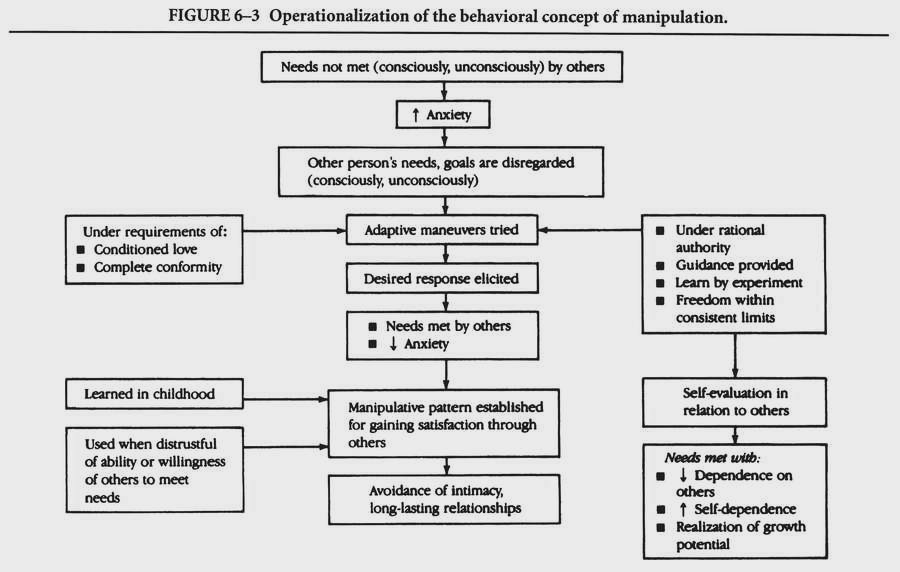
Definition: process of playing on and using others by unfair, insidious means to serve own purpose without regard for others’ needs; may take many forms; occurs consciously, unconsciously to some extent, in all interpersonal relations.
-
Operational definition:
-
Conflicting needs, goals exist between client and other person (e.g., nurse).
-
Other person perceives need as unacceptable, unreasonable.
-
Other person refuses to accept client’s need.
-
Client’s tension increases, and he or she begins to relate to others as objects.
-
Client increases attempts to influence others to fulfill his or her need.
-
Appears unaware of others’ needs.
-
Exhibits excessive dependency, helplessness, demands.
-
Sets others at odds (especially staff).
-
Rationalizes, gives logical reasons.
-
Uses deception, false promises, insincerity.
-
Questions and defies nurse’s authority and competence.
-
Nurse feels powerless and angry at having been used.
-
Assessment:
-
Acts out sexually, physically.
-
Dawdles, always last minute.
-
Uses insincere flattery; expects special favors, privileges.
-
Exploits generosity and fears of others.
-
Feels no guilt.
-
Plays one staff member against another.
-
Tests limits.
-
Finds weaknesses in others.
-
Makes excessive, unreasonable, unnecessary demands for staff time.
-
Pretends to be helpless, lonely, distraught, tearful.
-
Cannot distinguish between truth and falsehood.
-
Plays on sympathy or guilt.
-
Offers many excuses, lacks insight.
-
Pursues unpleasant issues without genuine regard for or feelings of individuals involved.
-
Intimidates, derogates, threatens, bargains, cajoles, violates rules to obtain reactions or privileges.
-
Betrays information.
-
Uses communication as a medium for manipulation, as verbal, nonverbal means to get others to cooperate, to behave in certain way, to get something from another for own use.
-
May be coercive, illogical, or skillfully deceptive.
-
Unable to learn from experience, i.e., repeats unacceptable behaviors despite negative consequences.
-
Analysis/nursing diagnosis: ineffective individual coping and impaired adjustment related to:
-
Mistrust and contemptuous view of others’ motivations.
-
Life experience of rejection, deception.
-
Low anxiety tolerance.
-
Inability to cope with tension.
-
Unmet dependency needs.
-
Need to avoid anxiety when cannot obtain gratification.
-
Need to obtain something that is forbidden, or need for instant gratification.
-
Attempt to put something over on another when no real advantage exists.
-
Intolerance of intimacy, maneuvering effectively to keep others at a safe distance to dilute the relationship by withdrawing and frustrating others or distracting attention away from self.
-
Attempt to demand attention, approval, disapproval.
-
Nursing care plan/implementation:
-
Long-term goal: define relationship as a mutual experience in learning and trust rather than a struggle for power and control.
-
Short-term goals: increase awareness of self and others; increase self-control; learn to accept limitations.
-
Promote use of “three C’s” - cooperation, compromise, collaboration - rather than exploitation or deception.
-
Decrease level and extent of manipulation.
-
Set firm, realistic goals, with clear, consistent expectations and limits.
-
Confront client regarding exploitation attempts; examine, discuss behavior.
-
Give positive reinforcement with concrete reinforcers for nonmanipulation, to lessen need for exploitive, deceptive, and self-destructive behaviors.
-
Ignore “wooden-leg” behavior (feigning illness to evoke sympathy).
-
Allow verbal anger; do not be intimidated; avoid giving desired response to obvious attempts to irritate.
-
Set consistent, firm, enforceable limits on destructive, aggressive behavior that impinges on others’ health, rights, and interests, and on excessive dependency; give reasons when you cannot meet requests.
-
Keep staff informed of rules and reasons; obtain staff consensus.
-
Enforce direct communication; encourage openness about real needs, feelings.
-
Do not accept gifts, favors, flattery, or other guises of manipulation.
-
Increase responsibility for self-control of actions.
-
Decide who (client, nurse) is responsible for what.
-
Provide opportunities for success to increase self-esteem, experiencing acceptance by others.
-
Evaluate actions, not verbal behavior; point out the difference between talk and action.
-
Support efforts to be responsible.
-
Assist client to increase emotional repertoire; explore alternative ways of relating interpersonally.
-
Avoid submission to control based on fear of punishment, retaliation, loss of affection.
-
Facilitate awareness of, and responsibility for, manipulative behavior and its effects on others.
-
Reflect back client’s behavior.
-
Discourage distortion and misuse of information.
-
Increase tolerance for differences and delayed gratification through behavior modification.
-
Insist on clear, consistent staff communication.
-
Avoid:
-
Labeling client as a “problem.”
-
Hostile, negative attitude.
-
Making a public issue of client’s behavior.
-
Being excessively rigid or permissive, inconsistent or ambiguous, argumentative or accusatory.
-
Health teaching: act as a role model; demonstrate how to deal with mistakes, human imperfections, by admitting mistakes in nonshameful, nonvirtuous ways.
-
Evaluation/outcome criteria: accepts limits; able to compromise, cooperate rather than deceive and exploit; acts responsibly, self-dependent.
-
Noncompliance and uncooperative behavior
-
Definition: consistently failing to meet the requirements of the prescribed treatment regimen, e.g., refusing to adhere to dietary restrictions or take required medications.
-
Assessment:
-
Refuses to participate in routine or planned activities.
-
Refuses medication.
-
Violates rules, ignores limits, and abuses privileges; acts out anger and frustration.
-
Analysis/nursing diagnosis: noncompliance related to:
-
Psychological factors: lack of knowledge; attitudes, beliefs, and values; denial of illness; rigid, defensive personality type; anxiety level (very high or very low); cannot accept limits or dependency (rebellious counterdependency).
-
Environmental factors: finances, transportation, lack of support system.
-
Health care agent-client relationship: client feels discounted and like an “object”; sees staff as uncaring, authoritative, controlling.
-
Health care regimen: too complicated; not enough benefit from following regimen; results in social stigma or social isolation; unpleasant side effects.
-
Nursing care plan/implementation:
-
General goal: reduce need to act out by nonadherence.
-
Take preventive action - be alert to signs of noncompliance, such as intent to leave against medical advice.
-
Explore feelings and reasons for lack of cooperation.
-
Assess and allay fears in client in reassuring manner.
-
Provide adequate information about, and reasons for, rules and procedures.
-
Avoid threats or physical restraints; maintain calm composure.
-
Demonstrate tact and firmness when confronting violations.
-
Offer alternatives.
-
Firmly insist on cooperation in selected important activities but not all activities.
-
Health teaching: increase knowledge base regarding health-related problem, procedures, or treatments and consequences.
-
Evaluation/outcome criteria: follows prescribed regimen.