1. Definition-a body image disturbance arises when a person is unable to accept the body as is and to adapt to it; a conflict develops between the body as it actually is and the body that is pictured mentally, that is, the ideal self.

  2. Analysis/nursing diagnosisbody image disturbance may be related to:
    1. Sensation of size change due to obesity, pregnancy, weight loss.
    2. Feelings of being dirty-may be imaginary due to hallucinogenic drugs, psychoses.
    3. Dual change of body structure and function due to trauma, amputation, stroke, etc.
    4. Progressive deformities due to chronic illness, burns, arthritis.
    5. Loss of body boundaries and depersonalization due to sensory deprivation, such as blindness, immobility, fatigue, stress, anesthesia. May also be due to psychoses or hallucinogenic drugs.

  1. Assessment:
    1. Loss of self-esteem; feelings of helplessness, worthlessness, shame, and guilt.
    2. Fear of abandonment may lead to appeals for sympathy by exhibiting helplessness and vulnerability.
    3. Feelings of castration (loss of self) and symbolic death; loss of wholeness.
    4. Existence of phantom pain (most clients).
    5. Passivity, lack of responsibility for use of disabled body parts.
  2. Nursing care plan/implementation:
    1. Avoid stereotyping person as being less competent now than previously by not referring to client as the “amputee.”
    2. Foster independence; encourage self-care by assessing what client can do for himself or herself.
    3. Help person set realistic short-term and longterm goals by exploring with the client his or her strengths and resources.
    4. Health teaching:
      1. Encourage family members to work through their feelings, to accept person as he or she presents self.
      2. Teach how to set realistic goals and limitations.
      3. Explain what phantom pain is; that it is a normal experience.
      4. Explain role and function of prosthetic devices, where and how to obtain them, and how to find assistance in their use.
  3. Evaluation/outcome criteria:
    1. Can acknowledge the loss and move through three stages of mourning (shock and disbelief, developing awareness, and resolution).
    2. Can discuss fears and concerns about loss of body part, its meaning, the problem of compensating for the loss, and reaction of persons (repulsion, rejection, and sympathy).
  1. Assessment:
    1. Feelings of shame (personal, private, selfjudgment of failure) due to loss of bowel and bladder control, speech function.
    2. Body image boundaries disrupted; contact with environment is hindered by inability to ambulate or manipulate environment physically; may result in personality deterioration due to diminished number of sensory experiences. Loses orientation to body sphere; feels confused, trapped in own body.
  2. Nursing care plan/implementation:
    1. Reduce frustration and infantilism due to communication problems by:
      1. Rewarding all speech efforts.
      2. Listening and observing for all nonverbal cues.
      3. Restating verbalizations to see if correct meaning is understood.
      4. Speaking slowly, using two-to three-word sentences.
    2. Assist reintegration of body parts and function; help regain awareness of paralyzed side by:
      1. Tactile stimulation.
      2. Verbal reminders of existence of affected parts.
      3. Direct visual contact via mirrors and grooming.
      4. Use of safety features (Posey belt).
    3. Health teaching: control of bowel and bladder function; how to prevent problems of immobility.
  3. Evaluation/outcome criteria: dignity is maintained while relearning to control elimination.
Emotional problems (anxiety, depression, sleep disturbance, fear of another myocardial infarction [MI]) during convalescence can seriously hamper rehabilitation. The adaptation and convalescence is influenced by the multiple symbolic meanings of the heart, for example:
  1. Seat of emotions (love, pride, fear, sadness).
  2. Center of the body (one-of-a-kind organ).
  3. Life itself (can no longer rely on the heart; failure of the heart means failure of life).
    1. Assessment:
      1. Attitude-overly cautious and restrictive; may result in boredom, weakness, insomnia, exaggerated dependency.
      2. Acceptance of illness-Use of denial may result in noncompliance.
      3. Behavior-self-destructive.
      4. Family conflicts-related to activity, diet.
      5. Effects of MI on:
        1. Changes in lifestyle-eating, smoking, drinking; activities, employment, sex.
        2. Family members-may be anxious, overprotective.
        3. Role in family-role reversal may result in loss of incentive for work.
        4. Dependence-independence-issues related to family conflicts (especially restrictive attitudes about desirable activity and dietary regimen).
        5. Job-social pressure to “slow down” may result in loss of job, reassignment, forced early retirement, “has-been” social status.
    2. Nursing care plan/implementation:
      1. Prevent “cardiac cripple” by shaping person’s and family’s attitude toward damaged organ.
        1. Instill optimism.
        2. Encourage productive living rather than inactivity.
      2. Set up a physical and mental activity program with client and mate.
      3. Provide anticipatory guidance regarding expected weakness, fear, uncertainty.
      4. Health teaching: nature of coronary disease, interpretation of medical regimen, effect on sexual behavior.
    3. Evaluation/outcome criteria:
      1. Adheres to medical regimen.
      2. Modifies lifestyle without becoming overly dependent on others.
  1. Definition: body weight exceeding 20% above the norm for person’s age, sex, and height constitutes obesity. Body mass index (BMI) is also used. Although a faulty adaptation, obesity may serve as a protection against more severe illness; it represents an effort to function better, be powerful, stay well, or be less sick. The problem may not be difficulty in losing weight; reducing may not be the appropriate cure.
  2. Assessment-characteristics:
    1. Age-one out of three persons under 30 years of age is more than 10% overweight.
    2. Increase risks for CVA, MI, diabetes.
    3. Feelings: self-hate, self-derogation, failure, helplessness; tendency to avoid clothes shopping and mirror reflections.
    4. Viewed by others as ugly, repulsive, lacking in will power, weak, unwilling to change, neurotic.
    5. Discrepancy between actual body size (real self) and person’s concept of it (ideal self).
    6. Pattern of successful weight loss followed quickly and repetitively by failure, that is, weight gain.
    7. Eating in response to outer environment (e.g., food odor, time of day, food availability, degree of stress, anger); not inner environment (hunger, increased gastric motility).
    8. Experiences less pleasure in physical activity; less active than others.
    9. All obese people are not the same.
      1. In obese newborns and infants, there is an increased number of adipocytes via hyperplastic process.
      2. In obese adults, there may be increased body fat deposits, resulting in increased size of adipocytes via hypertrophic process.
      3. When an obese infant becomes an obese adult, the result may be an increased number of cells available for fat storage.
    10. Loss of control of own body or eating behavior.
  3. Analysis/nursing diagnosis: Defensive coping related to eating disorder. Contributing factors:
    1. Genetic.
    2. Thermodynamic.
    3. Endocrine.
    4. Neuroregulatory.
    5. Biochemical factors in metabolism.
    6. Ethnic and family practices.
    7. Psychological:
      1. Compensation for feelings of helplessness and inadequacy.
      2. Maternal overprotection; overfed and forcefed, especially formula-fed infants.
      3. Food offered and used to relieve anxiety, frustration, anger, and rage can lead to difficulty in differentiating between hunger and other needs.
      4. As a child, food offered instead of love.
    8. Social:
      1. Food easily available.
      2. Use of motorized transportation and labor-saving devices.
      3. Refined carbohydrates.
      4. Social aspects of eating.
      5. Restaurant meals high in salt, sugar.
  4. Nursing care plan/implementation:
    1. Encourage prevention of lifelong body image problems.
      1. Support breastfeeding, where infant determines quantity consumed, not mother; work through her feelings against breastfeeding (fear of intimacy, dependence, feelings of repulsion, concern about confinement, and inability to produce enough milk).
      2. Help mothers to not overfeed the baby if formula-fed: suggest water between feedings; do not start solids until 6 months old or 14 pounds; do not enrich the prescribed formula.
      3. Help mothers differentiate between hunger and other infant cries; help her to try out different responses to the expressed needs other than offering food.
    2. Use case findings of obese infants, young children, and adolescents.
Human sexuality refers to all the characteristics of an individual (social, personal, and emotional) that are manifest in his or her relationships with others and that reflect gendergenital orientation.
  1. Components of sexual system
    1. Biological sexuality-refers to chromosomes, hormones, primary and secondary sex characteristics, and anatomical structure.
    2. Sexual identity-based on own feelings and perceptions of how well traits correspond with own feelings and concepts of maleness and femaleness; also includes gender identity.
    3. Gender identity-a sense of masculinity and femininity shaped by biological, environmental, and intrapsychic forces, as well as cultural traditions and education.
    4. Progressive deformities due to chronic illness, burns, arthritis.
    5. Sex role behavior-includes components of both sexual identity and gender identity. Aim: sexual fulfillment through masturbation, heterosexual, or homosexual experiences. Selection of behavior is influenced by personal value system and sexual, gender, and biological identity. Gender identity and roles are learned and constantly reinforced by input and feedback regarding social expectations and demands.

  2. Concepts and principles of human sexual response:
    1. Human sexual response involves not only the genitals but the total body.
    2. Factors in early postnatal and childhood periods influence gender identity, gender role, sex typing, and sexual responses in later life.
    3. Cultural and personally subjective variables influence ways of sexual expression and perception of what is satisfying.
    4. Healthy sexual expressions vary widely.
    5. Requirements for human sexual response:
      1. Intact central and peripheral nervous system to provide sensory perception, motor reaction.
      2. Intact circulatory system to produce vasocongestive response.
      3. Cultural and personally subjective variables influence ways of sexual expression and perception of what is satisfying.
      4. Freedom from guilt, anxiety, misconceptions, and interfering conditioned responses.
      5. Acceptable physical setting, usually private.
General Issues
  1. Issues in sexual practices with implications for counseling:
    1. Sex education-need to provide accurate and complete information on all aspects of sexuality to all people.
    2. Sexual-health care-should be part of total health care planning for all.
    3. Sexual orientation-need to avoid discrimination based on sexual orientation (such as homosexuality); the right to satisfying, nonexploitive relationships with others, regardless of gender.
    4. Sex and the law-sex between consenting adults not a legal concern.
    5. Explicit sexual material (pornography)-can be useful in fulfilling various needs in life, as in quadriplegia.
    6. Masturbation-a natural behavior at all ages; can fulfill a variety of needs.
    7. Availability of contraception for minors-the right of access to medical contraceptive care should be available to all ages.
    8. Abortion-confidentiality for minors.
    9. Treatment for sexually transmitted disease (STD)-naming of partners as part of STD control.
    10. Sex and the elderly-need opportunity for sexual expression; need privacy when in communal living setting.
    11. Sex and the disabled-need to have possible means available for rewarding sexual expressions.

  2. Sexual myths*
    Fact: What you don’t know can hurt you (note the high frequency of STD and abortions); myths can perpetuate fears and such misinformation as:
    1. Sex education-need to provide accurate and complete information on all aspects of sexuality to all people.
      1. Masturbation causes mental illness.
      2. Women don’t or shouldn’t have orgasms.
      3. Tampons cause STD.
      4. Plastic wrap works better than condoms.
      5. Coca-Cola is an effective douche.
      Fact: Lack of knowledge during initial experiences may result in fear and set precedent for future sexual reactions.
    2. Myths: The planned sex act is not OK and is immoral for “nice” girls. If a woman gets pregnant, it is her own fault. Contraceptives are solely a woman’s responsibility.
    3. Fact: Sex and contraception are the prerogative and responsibility of both partners.
    4. Myth: A good relationship is harmonious, free of conflict and disagreement (which are signs of rejection and incompatibility).
    5. Fact: Conflict can induce growth in self-understanding and in understanding of others.
    6. Myth: Sexual deviance (such as homosexuality) is a sign of personality disturbance.
    7. Fact: No single sexual behavior is the most desirable, effective, or satisfactory. Personal sexual choice is a fundamental right.
    8. Myth: A woman’s sexual needs and gratification should be secondary to her partner’s; a woman’s role is to satisfy others.
    9. Fact: A woman has as much right to sexual freedom and experience as a man.
    10. Myth: Menopause is an affliction signifying the end of sex.
    11. Fact: Many women do not suffer through menopause, and many report renewed sexual interest.
    12. Myth: Sexual activity past 60 years of age is not essential.
    13. Fact: Sexual activity is therapeutic because it:
      1. Affirms identity.
      2. Provides communication.
      3. Provides companionship.
      4. Meets intimacy needs.
    14. Myth: A woman’s sex drive decreases in postmenopausal period.
    15. Fact: The strength of the sex drive becomes greater as androgen overcomes the inhibitory action of estrogen.
    16. Myth: Men over age 60 cannot achieve an erection.
    17. Fact: According to Masters and Johnson, a major difference between the aging man and the younger man is the duration of each phase of the sexual cycle. The older man is slower in achieving an erection.
    18. Myth: Regular sexual activity cannot help the aging person’s loss of function.
    19. Fact: Research is revealing that “disuse atrophy” may lead to loss of sexual capacity. Regular sexual activity helps preserve sexual function.
Age Development of Sexual Behavior

First 18 months

  • Major source of pleasure from touch and oral exploration.

First 18 months

  • Major source of pleasure from touch and oral exploration.

18 months-3 years

  • Pleasurable and sexual feelings are associated with genitals (acts of urination and defecation). Masturbation without fantasy or eroticism.

3-6 years

  • Beginning resolution of Oedipus and Electra complexes; foundation for heterosexual relationships; masturbation with curiosity about genitals of opposite sex.

6-12 years

  • Peer relations with same sex; onset of sex play; morality and sexual attitudes taught and learned; phase of sexual tranquility.

12-18 years (adolescence)

  • Onset of puberty with biological development of secondary sex characteristics; menstruation and ejaculation occur.
  • Frequent masturbation. Intense anxiety and guilt may occur over heterosexual or homosexual behavior (petting, coitus, masturbation, STD, pregnancy, genital size).

18-23 years (early adulthood)

  • Maximum interpersonal and intrapsychic self-consciousness about sexuality. Issues: premarital coitus, sexual freedom.
  • Anxiety about: sexual competency, genital size, impotence, fear of pregnancy, rejection.

23-30 years

  • Focus on sexual activity in coupling and parenthood; mutual masturbation.

30-45 years (middle adulthood)

  • For women-peak sexuality without new sexual experiences. Conflict regarding extramarital sex may increase.
    Purpose of Interourse:
  • Need for body contact (and procreation until age 35+).
  • Physical expression of trust, love, and affection.
  • Reaffirmation of self-concept as sexually desirable and sexually competent due to worry about effects of aging.
    Sexual Dysfunctions:
  • Men: erectile dysfunction, premature ejaculation, decreasing libido.
  • Women: intermittent lack of orgasmic response, vaginismus, dyspareunia.
  • For either or both: changes or divergences in degree of sexual interest.
    Causes of Sexual Dysfunction (Men):
  • Overindulgence in food or drink.
  • Preoccupation with career and economic pursuits.
  • Mental or physical fatigue.
  • Boredom with monotony of relationship.
  • Drug dependency: alcohol, tobacco, certain medications.
  • Fear of failure.
  • Chronic illness: diabetes, alcoholism-peripheral neuropathy-impotence (smoking and drinking may result in decreased testosterone production); excessive smoking-vascular constriction-decreased libido; spinal cord injuries; prostatectomy, androgen deprivation therapy (for prostate cancer).
  • Self-devaluation due to accumulation of role function losses, sexual self-image, and body image.
  • Past history of lack of-sexual enjoyment in younger years.
    Causes of Sexual Dysfunction (Women):
  • Belief in myths regarding “shoulds and should nots” of frequency, variations, and enjoyment.
  • Widowhood: inhibition and loyalty to deceased.

45-65 years (later adulthood)

  • Menopause occurs.
  • Little or no fear of pregnancy; evidence of sexual activity differences in men and women: women may have increased pleasure, men take longer to reach orgasm; may prefer less strenuous mutual masturbation.

Over 65 years (old age)

  • Activity depends on earlier sexual attitude.
  • May suffer guilt and shame when engaging in sex.
  • Can have active and enjoyable sex life with continuing sex needs.
  • Age is not a barrier provided there is opportunity for sexual activity with a partner or for sublimated activities. Women in this age group outnumber men; single women outnumber single men by an even larger margin.
  1. Basic principles of sexual-health counseling
    1. There is no universal consensus about acceptable values in human sexuality. Each social group has very definite values regarding sex.
    2. Counselors need to examine own feelings, attitudes, values, biases, knowledge base.
    3. Help reduce fear, guilt, ignorance.
    4. Offer guidance and education rather than indoctrination or pressure to conform.
    5. Each person needs to be helped to make personal choices regarding sexual conduct.

  2. Counseling in sexual health
    1. General considerations:
      1. Create atmosphere of trust and acceptance for objective, nonjudgmental dialogue.
      2. Use language related to sexual behavior that is mutually comfortable and understood between client and nurse.
        1. Use alternative terms for definitions.
        2. Determine exact meaning of words and phrases because sexual words and expressions have different meanings to people with different backgrounds and experiences.
      3. Desensitize own stress reaction to the emotional component of taboo topics.
        1. Increase awareness of own sexual values, biases, prejudices, stereotypes, and fears.
        2. Avoid overreacting, underreacting.
      4. Become sensitively aware of interrelationships between sexual needs, fears, and behaviors and other aspects of living.
      5. Begin with commonly discussed areas (such as menstruation) and progress to discussion of individual sexual experiences (such as masturbation). Move from areas where there is less voluntary control (nocturnal emissions) to more responsibility and voluntary behavior (premature ejaculation).
      6. Offer educational information to dispel fears, myths; give tacit permission to explore sensitive areas.
      7. Bring into awareness possibly repressed feelings of guilt, anger, denial, and suppressed sexual feelings.
      8. Explore possible alternatives of sexual expression.
      9. Determine interrelationships among mental, social, physical, and sexual well-being.
    2. Assessment parameters:
      1. Self-awareness of body image, values, and attitudes toward human sexuality; comfort with own sexuality.
      2. Ability to identify sex problems on basis of own satisfaction or dissatisfaction.
      3. Developmental history, sex education, family relationships, cultural and ethnic values, and available support resources.
      4. Type and frequency of sexual behavior.
      5. Nature and quality of sex relations with others.
      6. Attitude toward and satisfaction with sexual activity.
      7. Expectations and goals.
    3. Nursing care plan/implementation
      1. Long-term goals
        1. Increase knowledge of reproductive system and types of sex behavior.
        2. Promote positive view of body and sex needs.
        3. Integrate sex needs into self-identity.
        4. Develop adaptive and satisfying patterns of sexual expression.
        5. Understand effects of physical illness on sexual performance.
      2. Primary sexual health interventions
        1. Goals: minimize stress factors, strengthen sexual integrity.
        2. Provide education to uninformed or misinformed.
        3. Identify stress factors (myths, stereotypes, negative parental attitudes).
      3. Secondary sexual health interventions: identify sexual problems early and refer for treatment.
    4. Evaluation/outcome criteria:
      1. Reduced impairment or dysfunction from acute sex problem or chronic, unresolved sex problem.
      2. Evaluate how client’s goals were achieved in terms of positive thoughts, feelings, and satisfying sexual behaviors.
Interview Step Rationale

Open the discussion of sexual matters subtly with an openended question: "People with your illness or stresses often experience other difficulties, sometimes with sexual functioning.”

This gentle opening lets the client know that other people have difficulties, too. It gives the client permission to talk with the nurse about sexual matters without labeling these matters as problems.

Follow up with another open-ended question about the client’s current status: “Has your illness or stresses made any difference in what it’s like for you to be a wife or husband (lover, boyfriend, girlfriend, sexual partner)?

The phrasing of this question enables the client to acknowledge a problem without admitting a shortcoming.

If the client speaks of having a dysfunction, ask about its effect: “How does this affect you?” or “How do you feel about it?”

This indicates that the nurse is willing to explore sexual matters more completely.

Ask about the severity and duration of the dysfunction: “Is it always difficult to control your ejaculation?" “Tell me when you first noticed this.”

These questions are directed at identifying the specific problem.

sk about the effects on the client’s sexual partner: “Has this affected your relationship with your partner?"

This question is directed toward exploring the interactional aspects of the identified problem.

Ask what the client has already done to alleviate the situation: “Have you made any adjustments in your sexual activity?”

This question yields data that will help the nurse to formulate an intervention plan.

Ask the client if and how he or she would like the situation changed: “How would you like to change the situation to make it more satisfying?”

This question conveys the negotiated nature of the therapeutic relationship, in which the client’s own goals play an important part.


  1. Masturbation
    1. Definition-act of achieving sexual arousal and orgasm through manual or mechanical stimulation of the sex organs.
    2. Characteristics
      1. Can be an interpersonal as well as a solitary activity.
      2. “It is a healthy and appropriate sexual activity, playing an important role in ultimate consolidation of one’s sexual identity.”*
      3. Accompanied by fantasies that are important for:
        1. Physically disabled.
        2. Fatigued.
        3. Compensation for unreachable goals and unfulfilled wishes.
        4. Rehearsal for future sexual relations.
        5. Absence or impersonal action of partner.
      4. Can help release tension harmlessly.
    3. Concepts and principles related to masturbation
      1. Staff’s feelings and reactions influence their responses to client and affect continuation of masturbation (that is, negative staff actions increase client’s frustration, which increases masturbation).
      2. Masturbation is normal and universal, not physically or psychologically harmful in itself.
      3. Pleasurable genital sensations are important for increasing self-pride, finding gratification in own body, increasing sense of personal value of being lovable, helping to prepare for adult sexual role.
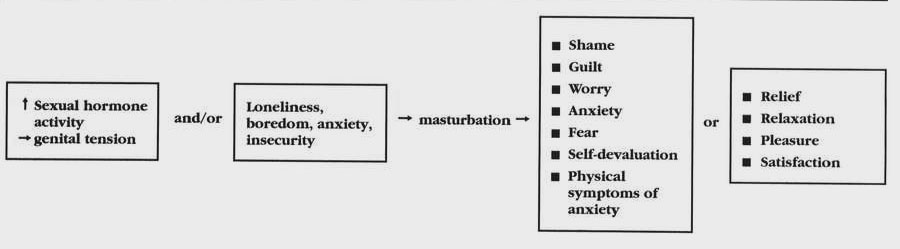
      4. Excessive masturbation-some needs not being met through interpersonal relations; may use behavior to avoid interpersonal relations.
      5. Activity may be related to:
        1. Curiosity, experimentation.
        2. Tension reduction, pleasure.
        3. Enhanced interest in sexual development.
        4. Fear and avoidance of social relationships.
    4. Nursing care plan:
      1. Long-term goals
        1. Gain insight into preference for masturbation.
        2. Relieve accompanying guilt, worry, selfdevaluation.
      2. Short-term goals
        1. Clarify myths regarding masturbation.
        2. Help client see masturbation as an acceptable sexual activity for individuals of all ages.
        3. Set limits on masturbation in inappropriate settings.
    5. Nursing implementation:
      1. Examine, control nurse’s own negative feelings; show respect.
      2. Avoid: reinforcement of guilt and self-devaluation; scorn; threats, punishment, anger, alarm reaction; use of masturbation for rebellion in power struggle between staff and client.
      3. Identify client’s unmet needs; consider purpose served by masturbation (may be useful behavior).
      4. Examine pattern in which behavior occurs.
      5. Intervene when degree of functioning in other daily life activities is impaired.
        1. Remain calm, accepting, but nonsanctioning.
        2. Promptly help clarify client’s feelings, thoughts, at stressful time.
        3. Review precipitating events.
        4. Be a neutral “sounding board”; avoid evasiveness.
        5. If unable to handle situation, find someone who can.
      6. For clients who masturbate at inappropriate times or in inappropriate places:
        1. Give special attention when they are not masturbating.
        2. Encourage new interests and activities, but not immediately after observing masturbation.
        3. Keep clients distracted, occupied with interesting activities.
      7. Health teaching: explain myths and teach facts regarding cause and effects.
    6. Evaluation/outcome criteria:
      1. Acknowledges function of own sexual organs.
      2. States sexual experience is satisfying.
      3. Views sexuality as pleasurable and wholesome.
      4. Views sex organs as acceptable, enjoyable, and valued part of body image.
      5. Self-image as fully functioning person is restored and maintained.
  1. Homosexuality
    1. Definition-alternative sexual behavior; applied to sexual relations between persons of the same sex.
    2. Theories regarding causes
      1. Hereditary tendencies.
      2. Imbalance of sex hormones.
      3. Environmental influences and conditioning factors, related to learning and psychodynamic theories.
        1. Defense against unsatisfying relationship with father.
        2. Unsatisfactory and threatening early relationships with opposite sex.
        3. Oedipal attachment to parent.
        4. Seductive parent (incest).
        5. Castration fear.
        6. Labeling and guilt leading to sexual acting out.
        7. Faulty sex education.
      4. Preferred choice as a lifestyle.
    3. Nursing care plan/implementation:
      1. Nurse needs to be aware of and work through own attitudes that may interfere with providing care.
      2. Accept and respect lifestyle of gay (male homosexual) or lesbian (female homosexual) client.
      3. Assess and treat for possible sexually trans mitted diseases and hepatitis.
      4. Health teaching: assess and add to knowledge base about alternatives in sexual behavior.
    4. Evaluation/outcome criteria: expresses self confidence and positive self-image; able to sustain satisfying sexual behavior with chosen partner and avoid at-risk behaviors for STDs.

  2. Sex and the disabled person
    1. Assessment parameters:
      1. Previous level of sex functioning and conflict.
      2. Client's view of sex activity (self and mutual pleasure, tension release, procreation, control).
      3. Cultural environment influence on body im age).
      4. Degree of acceptance of illness.
      5. Support system (partner, family, support group)
      6. Body image and self-esteem.
      7. Outlook on future.
    2. Analysis/nursing diagnosis: Sexual dysfunction associated with physical illness related to:
      1. Disinterest in sexual activity.
      2. Fear of precipitating or aggravating physical illness through sexual activity.
      3. Use of illness as excuse to avoid feared or undesired sex.
      4. Physical inability or discomfort during sexual activity.
    3. Nursing care plan/implementation:
      1. Approach with nonjudgmental attitude.
      2. Elicit concerns about current physical state and perceptions of changes in sexuality.
      3. Observe nonverbal clues of concern.
      4. Identify genital assets.
      5. Support client and partner during adjustment to current state.
      6. Explore culturally acceptable sublimation activities.
      7. Promote adjustment to body image change.
      8. Health teaching:
        1. Teach self-help skills
        2. Teach partner to care for client's physical needs.
        3. Teach alternate sex behaviors and acceptable sublimation (touching, for example).
    4. Evaluation/outcome criteria: attains satisfaction with adaptive alternatives of sexual expressions; has a positive attitude toward self, body, and sexual activity.

  3. Inappropriate sexual behavior
    1. Assessment: public exhibitions of sexual behav iors that are offensive to others; making sexual advances to other clients or staff.
    2. Analysis/nursing diagnosis: onflict with social order related to:
      1. Acting out angry and hostile feelings.
      2. Lack of awareness of hospital and agency rules regarding acceptable public behavior.
      3. Variation in cultural interpretations of what is acceptable public behavior.
      4. Reaction to unintended seductiveness by person's attire, posture, tone, or choice of terminology.
    3. Nursing care plan/implementation:
      1. Maintain calm, nonjudgmental attitude.
      2. Set firm limits on unacceptable behavior.
      3. Encourage verbalization of feelings rather than unacceptable physical expression.
      4. Reinforce appropriate behavior.
      5. Provide constructive diversional activity for clients or patients.
      6. Health teaching: explain rules regarding pub lic behavior; teach acceptable ways to express anger.

  4. Evaluation/outcome criteria: verbalizes anger rather than acting out; accepts rules regarding behavior in public.


The increasing of Sexual hormone activity to genital tension. and/or of Loneliness, boredom, anxiety, insecurity to masturbation to Shame. Guilt. Worry .Anxiety .Fear. self devaluation .Physical symptoms of anxiety. or. Relief, Relaxation, Pleaser, Satisfaction.