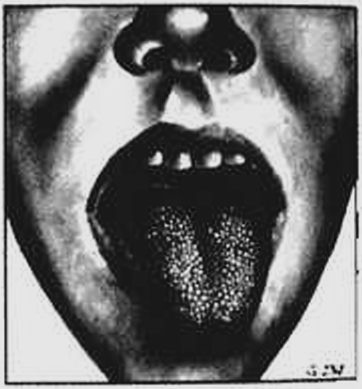
First day
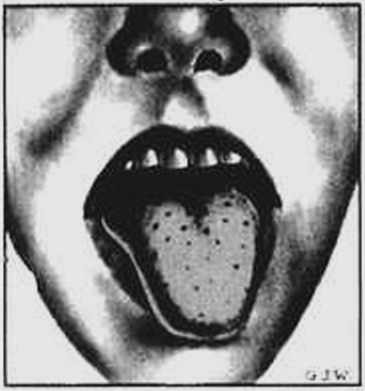
White strawberry tongue
| Clinical Manifestations | Therapeutic Management Complications/ | Nursing Considerations |
|---|---|---|
|
Prodromal stage: Absent in children, present in adults and adolescents; consists of lowgrade fever, headache, malaise, anorexia, mild conjunctivitis, coryza, sore throat, cough, and lymphadenopathy; lasts for 1-5 days, subsides 1 day after appearance of rash
Rash: First appears on face and rapidly spreads downward to neck, arms, trunk, and legs; by end of first day, body is covered with a discrete, pinkish red maculopapular exanthema; disappears in same order as it began and is usually gone by third day
Constitutional signs and symptoms: Occasionally low-grade fever, headache, malaise, and lymphadenopathy
|
No treatment necessary other than antipyretics for low-grade fever and analgesics for discomfort
Complications:Rare (arthritis, encephalitis, or purpura); most benign of all childhood communicable diseases; greatest danger is teratogenic effect on fetus
|
Reassure parents of benign nature of illness in affected child
Use comfort measures as necessary
Isolate child from pregnant women
|
|
Prodromal stage: Abrupt high fever, pulse increased out of proportion to fever, vomiting, headache, chills, malaise, abdominal pain
Enanthema: Tonsils enlarged, edematous, reddened, and covered with patches of exudate; in severe cases appearance resembles membrane seen in diphtheria; pharynx is edematous and beefy red; during first 1-2 days tongue is coated and papillae become red and swollen (white strawberry tongue); by fourth or fifth day white coat sloughs off, leaving prominent papillae (red strawberry tongue); palate is covered with erythematous punctate lesions
Exanthema: Rash appears within 12 hours after prodromal stage; red pinhead-sized punctate lesions rapidly become generalized but are absent on face, which becomes flushed with striking circumoral pallor; rash is more intense in folds of joints; by end of first week desquamation begins (fine, sandpaper-like on torso; sheetlike sloughing on palms and soles), which may be complete by 3 weeks or longer
|
Treatment of choice is a full course of penicillin (or erythromycin in penicillin-sensitive children); fever should subside 24 hr after beginning therapy
Antibiotic therapy for newly diagnosed carriers (nose or throat cultures positive for streptococci)
Supportive measures: Bed rest during febrile phase, analgesics for sore throat
Complications:
Otitis media
Peritonsillar abscess Sinusitis
Glomerulonephritis
Carditis, polyarthritis (uncommon)
|
Institute respiratory precautions until 24 hr after initiation of treatment
Ensure compliance with oral antibiotic therapy (intramuscular benzathine penicillin G [Bicillin] may be given if parents’ reliability in giving oral drugs is questionable)
Maintain bed rest during febrile phase; provide quiet activity during convalescent period
Relieve discomfort of sore throat with analgesics, gargles, lozenges, antiseptic throat sprays (Chloraseptic), and inhalation of cool mist
Encourage fluids during febrile phase; avoid irritating liquids (citrus juices) or rough foods; when child is able to eat, begin with soft diet
Advise parents to consult practitioner if fever persists after beginning therapy
Discuss procedures for preventing spread of infection
|