Pulmonary Disorders
| Name | Definition | Age Group | Etiology | Assessment: Definitive Clinical Signs and Symptoms | Plan: Specifics of Treatment | Prognosis |
| Bronchiolitis/ respiratory syncytial virus (RSV) | Acute viral infection of lower respiratory tract (small, low bronchioles), with resultant trapping of air | Infants 2-12 months (peak at 2-5 months) | Respiratory syncytial virus |
Hyperinflation of alveoli Scattered areas of atelectasis Acute, severe respiratory distress for first 48-72 hours, followed by rapid recovery |
Supportive care during acute phase:
|
Excellent (less than 1% mortality rate) |
| Croup (acute spasmodic laryngitis) | Paroxysmal attacks (spasms of larynx) | 6 months-3 years | Viral (possible allergy or psychogenic) |
Most common onset at night Inspiratory stridor
"Croupy" barking cough Dyspnea Anxiety |
Teach parents - turn on hot water in bathroom and close door (steam)
|
Excellent (but likely to recur) |
| Laryngotracheobronchitis (LTB) | Acute infection of lower respiratory tract: larynx, trachea, and bronchi | Children less than 5 years | Viral (possible secondary bacterial infection) |
Inspiratory stridor
High fever
Signs and symptoms of severe respiratory distress
Hoarseness, progressing to aphonia and respiratory arrest without treatment |
Hospitalization:
|
Good |
| Epiglottitis | Extremely acute, severe, and rapid, progressive swelling (due to infection) of epiglottis and surrounding tissue | 2-5 years | Bacterial (H. influenzae type b) |
Abrupt onset - rapid progression; medical emergency
Dyspnea, dysphagia Sit up/chin thrust/mouth open Thick muffled voice Cherry red. swollen epiglottis |
Do
not
visualize epiglottis unless airway support is immediately available
Will need endotracheal tube or tracheostomy for 24 - 18 hours to maintain patent airway IV ampicilin for 10-14 days to treat bacterial infection IV corticosteroids (e.g., Solu-Cortef) to reduce inflammation |
Very good if detected and treated early
Prevent via Hib immunization |
| Nursing Actions | Rationale |
| Explain purpose of tent to parents and child; stress it is temporary, to make breathing easier. | Relieves anxiety. |
| Inspect tent for cracks, tears. Repair or replace prn. | Leaks will allow oxygen to escape. |
| Place unit at head of bed. | Child’s upper torso and head must be inside tent. |
| Cover bed with rubber/plastic sheet. | Keeps mattress dry. |
| Apply extra linen to bed under tent. | Absorbs extra dampness, wetness. |
| Secure metal frame to bedspring, and fasten tent to frame. | Prevents collapse of tent and keeps it open. |
| Select “cool mode” by using the control switch. | Provides cool air to reduce swelling and edema. |
| Close zippers and tuck in edges tightly. | Prevents loss of oxygen. |
| Flood” tent with oxygen for 5 minutes (flow rate = 15 L/min). | Raises oxygen concentration centration at least q2h. |
| Adjust flow rate per physician's order. | Usual flow rate is 8-10 L/min to maintain 35-40% oxygen concentration. |
| Monitor pulse oximetry or use oxygen analyzer to check concentration at least q2h. | Achieves desired therapeutic O2 levels |
| Place child in tent-stay with child. | Relieves anxiety. |
| Place folded towel/blanket around child’s head; stockinette cap for infant’s head. | Keeps child dry and prevents heat loss. |
| Cover child with blanket. | Avoids chilling. |
Selection of toys:
|
|
| Change child’s clothes and bed linens frequently (q4h or pm). | High humidity in tent will cause moisture to collect on these items. |
| Objectives |
ACTIONS |
|||
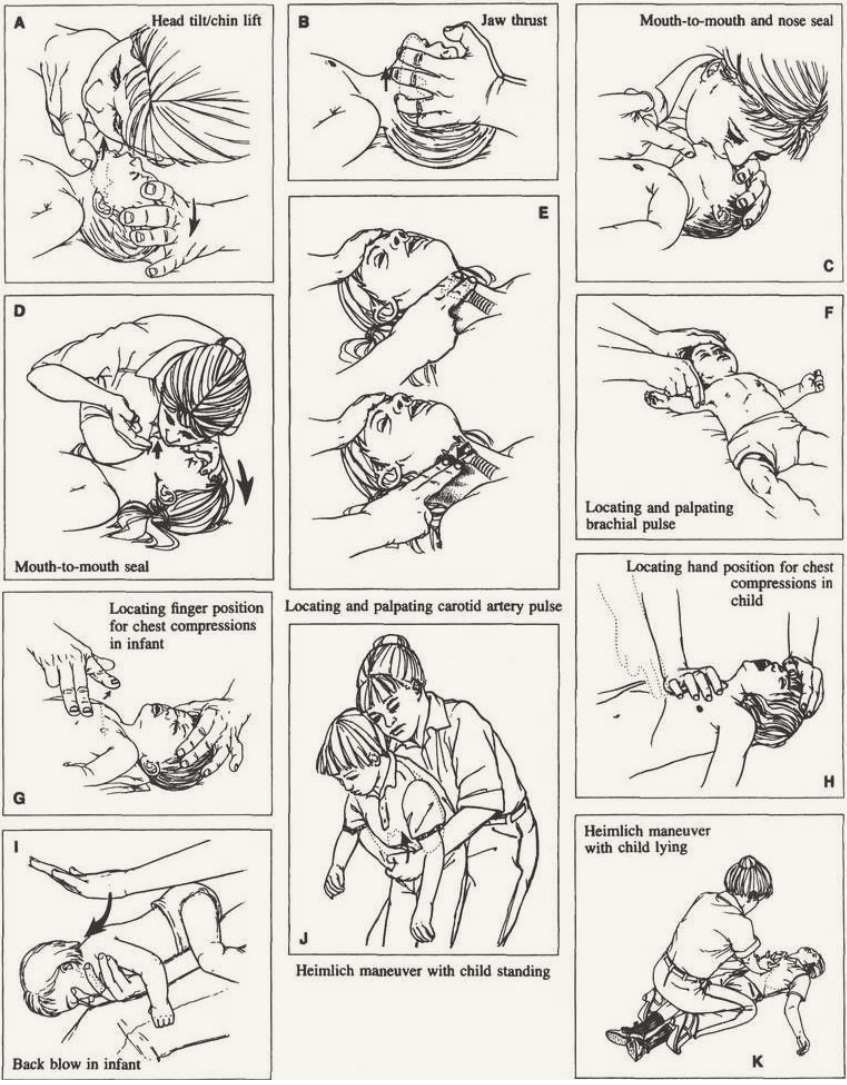
| Adult (>8 years) | Child (1-8 years) | Infant (< 1 year) | ||
| AIRWAY | Assessment: determine unresponsiveness. | Tap or gently shake shoulder. | ||
| Say, "Are you okay?" | Speak loudly. | |||
| Get help. | Activate EMS. | Shout for help. If second rescuer available, have person activate EMS. | ||
| Position the victim. | Turn on back as a unit, supporting head and neck if necessary (4-10 seconds). | |||
| Open the airway. | Head tilt/chin lift. | |||
| BREATHING | Assessment: determine breathlessness. | Maintain open airway. Place ear over mouth, observing chest. Look, listen, feel for breathing (3-5 seconds). | ||
| Give 2 rescue breaths. | Maintain open airway. | |||
| Seal mouth to mouth. | Mouth to nose/mouth. | |||
| Give 2 slow breaths. Observe chest rise. Allow lung deflation between breaths. | ||||
| 1 1/2-2 seconds each | 1 -1 1/2 seconds each | |||
| Option for obstructed airway. | Reposition victim's head. Try again to give rescue breaths. | |||
| Activate EMS. | ||||
|
Give 5 subdiaphragmatic abdoominal thrusts (the Heimlich maneuver) |
Give 5 back blows. | |||
| Give 5 chest thrusts. | ||||
| Tongue-jaw lift and finger. | Tongue-jaw lift, but finger sweep only if you finger sweep. see a foreign object. | |||
| If unsuccessful, repeat a, c, and d until successful. | ||||
| CIRCULATION | Assessment: determine pulselessness | Feel for carotid pulse with one hand; maintain head tilt with the other (5-10 seconds). | Feel for brachial pulse: keep head-tilt. | |
| CPR |
Pulse absent:
begin chest compressions landmark check |
Run middle finger along bottom edge of rib cage to notch at center (top of sternum). | Imagine a line drawn between the nipples. | |
| Hand position. | Place index finger next to finger on notch. | Place 2-3 fingers on sternum. 1 finger's width below line. Depress 1/2-1 in. | ||
| Two hands next to index finger. Depress 1 1/2 — 2 in. | Heel of one hand next to index finger. Depress 1 - 1 1/2 in. | |||
| Compression rate. | 80-100/minute | 100/minute | At least 100/min | |
| Compressions to breaths. | 2 breaths to every 15 compressions | 1 breath to every 5 compressions | ||
| Number of cycles. | 4 | 20 (approximately 1 minute) | ||
| Reassessment. | Feel for carotid pulse. | Feel for brachial pulse. | ||
| If no pulse, resume CPR, starting with compressions. | If alone, activate EMS. If no pulse, resume CPR, starting with compressions. | |||
| Pulse present; not breathing: begin rescue breathing. | 1 breath every 5 seconds (12/minute) | 1 breath every 3 seconds (20/minute) | ||
| Step | Objective | Actions |
| Step 1: AIRWAY | One rescuer (ventilator): Assessment: determine unresponsiveness. | Tap or gently shake shoulder. |
| Shout, "Are you okay?" | ||
| Gill for help. | Activate EMS. | |
| Position the victim. | Turn on back if necessary (4-10 seconds). | |
| Open the airway. | Use a proper technique to open airway. | |
| Step 2: BREATHING | Assessment: determine breathlessness. | Look, listen, and feel (3-5 seconds). |
| Ventilate twice. | Observe chest rise: 1-1.5 second/inspiration. | |
| Step 3: CIRCULATION | Assessment: determine pulselessness. | Feel for carotid pulse (5-10 seconds). |
| State assessment results. | Say, "No pulse." | |
| Other rescuer (compressor): Get into position for compressions. | Hand, shoulders in correct position. | |
| Locate landmark notch. | Landmark check. | |
| Step 4: COMPRESSION/ VENTILATION CYCLES | Compressor: begin chest compressions. | Correct ratio compressions/venlilations: 5:1 |
| Compression rate: 80-100/minute (5 compressions/3-4 seconds). | ||
| Say any helpful mnemonic. | ||
| Slop compressing for each ventilation. | ||
| Ventilator: ventilate after every 5th compression and check compression effectiveness, (Minimum of 10 cycles.) | Ventilate 1 time (1.5-2 seconds/inspiration). | |
| Check pulse occasionally to assess compressions. | ||
| Step 5: CALL FOR SWITCH | Compressor: coll for switch when fatigued. | Give clear signal Io change. |
| Compressor completes 5th compression. | ||
| Ventilator completes ventilation after 5th compression. | ||
| Step 6: SWITCH | Simultaneously switch: | |
| Ventilator: move to chest. | Move to chest. | |
| Become compressor. | ||
| Get into position for compressions. | ||
| Locate landmark notch. | ||
| Compressor: move Io head. | Move to head. | |
| Become ventilator. | ||
| Check carotid pulse (5 seconds). | ||
| Say, "No pulse." | ||
| Ventilate once (1.5-2 seconds/inspiration). | ||
| Step 7: CONTINUE CPR | Resume compression/ventilation | Resume Step 4. |
| The trully choking child cannot speak, become cyanotic, and collapses | ||||
| Objectives | Actions | |||
| Adult (over 8 years) | Child (1 to 8 years) | Infant (under 1 year) | ||
| CONSCIOUS VICTIM | Assessment: Determine airway obstruction | Ask, "Are you choking?" Determine if victim can cough or speak. | Observe breathing difficulty, ineffective cough, no strong cry. | |
| Act to relieve obstruction |
Perform up to 5 diaphragmatic abdominal thrusts (Heimlich maneuver). |
Give 5 back blows. | ||
| Give 5 chest thrusts. | ||||
| Be persistent. | Repeat Stop 2 until obstruction is relieved or victim becomes unconscious. | |||
| VICTIM WHO BECOMES UNCONSCIOUS | Position the victim: call for help. | Turn on back as a unit, supporting head and neck, face up, arms by sides. Call out, "Help!" Activate EMS. If second rescuer available, have person activate EMS. | ||
| Check for foreign body. | Perform tongue-jaw lift and finger sweep. | Perform longue-jaw lift. Remove foreign object only if you actually see it. | ||
| Give rescue breaths, | Open ifreairway with head-lilt/chin-lift Try to give rescue breaths. If airway is obstructed, reposition head and try to ventilate again. | |||
| Act to relieve obstruction | Perform up to 5 subdiaphragmatic abdominal thrusts(Heimlich Maneuver). | Give 5 back blows. | ||
| Give 5 chest thrusts. | ||||
| Be persistent. | Repeat steps 4-6 until obstruction is relieved. | |||
| UNCONSCIOUS VICTIM | Assessment: Determine unresponsiveness. |
Top or gently shake shoulder. Shout, "Are you okay?" |
Top or gently shake shoulder. | |
| If unresponsive, activate EMS. | ||||
| Call out for help: position the victim. | Turn on back as a unit, supporting head and neck, face up, arms by sides. | |||
| Call out for help. | ||||
| Open the airway. | Head-tilt/chin-lift. | Head-tilt/chin-lift, but do not till too for. | ||
| Assessment: Determine breathlessness. | Maintain on open oirway. Ear over mouth; observe chest, look, listen, feel for breathing (3-5 seconds). | |||
| Give rescue breaths. | Make mouth-to-mouth seal. | Make mouth-to-nose-and-mouth seal. | ||
| Try to give rescue breaths. | ||||
| If chest is not rising, try | Reposition head. Try rescue breaths again. | |||
| Activate the EMS system | If airway obstruction not relieved after about 1 minute, activate EMS as rapidly as possible. | |||
| Act to relieve obslruc- | Perform up to 5 subdiaphragmatic abdominal thrusts (Heimlich maneuver). | Give 5 back blows. | ||
| Give 5 chest thrusts. | ||||
| Check for foreign body. | Perform tongue-jaw lift and finger sweep. | Perform tongue-jaw lift. Remove foreign object only if you actually see it. | ||
| Rescue breaths. | Open the airways with head-tilt/chin-lift. Try opain Io give rescue breaths. | |||
| Be persistent. | Repeat steps 8-10 until obstruction is relieved. | |||
| Concern | Facts |
| Cause | Unknown (possibly related to delayed maturation of cardiorespiratory system) |
| Incidence | Fewer than 3500 cases annually; leading cause of death between ages 1 month and 1 year |
| When | Occurs during sleep (nap, night) |
| Age | Peak at 2-4 months; 95% of cases occur by age 6 months |
| Sex | More common in boys |
| Race | More common in African Americans and Native Americans |
| Season | More common in winter, peaks in January |
| Siblings | May have greater incidence |
| Perinatal | More common in preterm infants, in
multiple
births, and in infants with
low Apgar scores
|
| Socioeconomic | More common in lower socioeconomic classes
|
| Feeding habits | More common in bottle-fed infants; less common in breast-fed infants. |
| Means of prevention | Supine (on back) sleeping position prevention (mnemonic: “back to sleep”) |