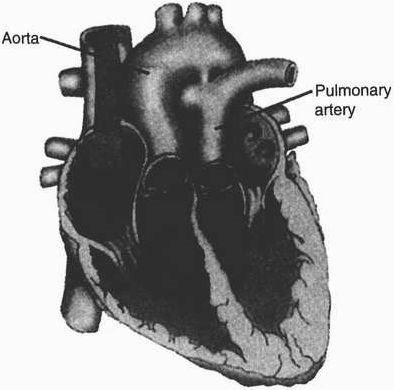
Transposition of the great arteries. The aorta and the pulmonary artery are reversed; i.e., the aorta rises from the right instead of the left ventricle, and the pulmonary artery arises from the left instead of the right ventricle. Systemic venous blood (unoxygenated blood) returns to the right side of the heart to pass through the aorta back to the body without being oxygenated because of bypassing the lungs. The pulmonary venous blood (oxygenated blood) enters the left side of the heart, returning to the lungs via the pulmonary artery. The systemic (unoxygenated) and pulmonary (oxygenated) circulations are totally separate. There must be some opening (i.e., patent ductus arteriosus or septal defect) to allow blood to mix. (From Ashwill, JW, and Droske, SC: Nursing Care of Children: Principles and Practice. WB Saunders, Philadelphia, 1997.)
-
-
-
-
Clubbing of fingers and toes - due to chronic hypoxia.
-
Polycythemia (increased red blood cells [RBCs]) with possible thrombi/emboli formation.
-
Analysis/nursing diagnosis:
-
Ineffective breathing pattern
related to tachypnea and respiratory infection.
-
Activity intolerance
related to tachycardia and hypoxia.
-
Altered nutrition, less than body requirements,
related to difficulty in feeding.
-
Risk for infection
related to poor nutritional status.
-
Knowledge deficit
related to diagnostic procedures, condition, surgicai/medical treatments, prognosis.
-
Nursing care plan/implementation:
-
promote adequate oxygenation.
-
Administer oxygen per physician’s order/prn.
-
Use loose-fitting clothing; tape diapers loosely to
avoid
pressure on abdominal organs, which could impinge on diaphragm and impede respiration.
-
Position:
neck slightly hyperextended to keep airway patent; place in knee-chest (squatting) position to relieve “Tet. spell” (choking spell).
-
Suction prn to clear the airway.
-
Administer
digoxin,
per physician’s order, to slow and strengthen heart’s pumping action (refer for pediatric pulse rate norms).