GROWTH AND DEVELOPMENT
Biologic Foundations of Reproduction
General overview: This review of the structures, functions, and important assessment characteristics of the reproductive system provides essential components of the database required for accurate nursing judgments. Comparing normal characteristics and established patterns with nursing assessment findings assists in identifying patient needs and in planning, implementing, and evaluating appropriate goal directed nursing interventions.
Female Reproductive Anatomy and Physiology
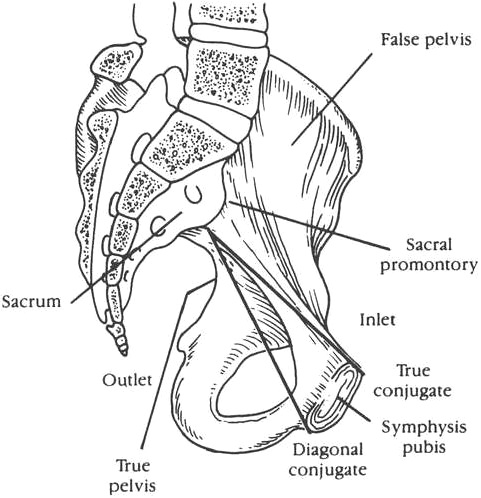
FIGURE 4-1 The female pelvis.
-
Structure of pelvis (Figure 4-1)
-
Two hip bones (right and left innominate: sacrum, coccyx).
-
False pelvis - upper portion above brim, supportive structure for uterus during last half of pregnancy.
-
True pelvis - below brim; pelvic inlet, midcavity, pelvic outlet comprise this structure. Fetus passes through during birth.
-
Pelvic measurements
-
Diagonal conjugate - 12.5 cm or greater is adequate size; measured by examiner.
-
Conjugate vera - 11 cm is adequate size; measured by x-ray.
-
Obstetric conjugate - measured by x-ray.
-
Tuber-ischial diameter - 9 to 11 cm indicates adequate size; measured by examiner.
-
Female external organs
-
Mons veneris - protects symphysis.
-
Labia majora - covers, protects labia minora.
-
Labia minora - two located within labia majora
-
Clitoris - small erectile tissue.
-
Hymen - thin membrane at opening of vagina.
-
Urinary meatus - opening of urethra.
-
Bartholin glands - producer of alkaline secretions that enhance sperm motility, viability.
FIGURE 4-2 Female internal reproductive organs.
-
Internal structures (Figure 4-2)
-
Vagina - outlet for menstrual flow, depository of semen, lower birth canal.
-
Cervix - uterine outlet.
-
Uterus - muscular organ that houses fetus during gestation.
-
Fallopian tubes - two tubes stretching from cornua of uterus to ovaries; transport ovum.
-
Ovaries - two oval-shaped structures that produce ovum and hormones (estrogen and progesterone).
-
Breasts - two mammary glands capable of secreting milk for infant nourishment.
FIGURE 4-3 The menstrual cycle. (From Thomas, CL [ed]: Taber’s Cyclopedic Medical Dictionary, ed. 18. FA Davis, Philadelphia, 1997.)
-
Menstrual cycle (Figure 4-3)
-
Reproductive hormones
-
Follicle-stimulating hormone (FSH) - secreted during the first half of cycle; stimulates development of graafian follicle; secreted by anterior pituitary.
-
Interstitial cell-stimulating hormone, luteinizing hormone (ICSH, LH) - stimulates ovulation and development of corpus luteum; secreted by pituitary.
-
Estrogen - assists in ovarian follicle maturation; stimulates endometrial thickening; responsible for development of secondary sex characteristics; maintains endometrium during pregnancy. Secreted by ovaries and adrenal cortex during cycle and by placenta during pregnancy.
-
Progesterone - aids in endometrial thickening; facilitates secretory changes; maintains uterine lining for implantation and early pregnancy; relaxes smooth muscle. Secreted by corpus luteum and placenta.
-
Prostaglandins - substances produced by various body organs that act hormonally on the endometrium to influence the onset and continuation of labor. A medication that may be used to facilitate onset of second trimester abortion; also used to efface the cervix before induction of labor in term pregnancies.
-
Ovulation - maturation and release of egg from ovary; generally occurs 14 days before beginning of next menses.
-
Menstruation - vaginal discharge of blood and fragments of the endometrium; cyclic; occurs in response to dropping levels of estrogen and progesterone.
-
Fertilization - impregnation of ovum by sperm.
-
Implantation - fertilized ovum attaches to uterine wall for growth.
-
Menopause - normally occurring cessation of menses with gradual decrease in amount of flow and increase in the time between periods at end of fertility cycle; average age, 51. Early menopause rare but may be influenced by hypothyroidism, surgical ovarian removal, overexposure to radiation. Treatments during menopause for symptomrelief: hormonal replacement therapy, vitamins B and E for hot flashes, vaginal creams for dyspareunia (painfill intercourse), and calcium for osteoporosis.
-
Spinnbarkheit - stretchable, thin cervical mucus present at ovulation.
-
Assessment of reproductive tract/reproductive health:
-
Health history
-
Menarche: onset and duration.
-
Menstrual problems.
-
Contraceptive use.
-
Pregnancy history.
-
Fertility problems.
-
Lifestyle choices that may have an impact on health and reproductive decision making.
-
Physical examination
-
External, internal reproductive organs.
-
Breast examination.
-
Mammography - every 1-2 years for women beginning age 40; annually beginning age 50; more frequently if have risk factors for breast cancer:
-
Mother, daughter, or sister had breast cancer.
-
Menses before age 11, or menopause before age 45 or after age 55.
-
Previous benign needle biopsies.
-
Birth of first child > 30 years old.
-
High-fat diet, obesity.
-
Nulliparous.
-
Excessive alcohol consumption.
-
Personal history of cancer.
-
Defects in certain genes (BRCA1 and BRCA2).
-
Pap smear - First Papanicolaou (Pap) smear at age 18 or earlier if sexually active; then annually until 3 consecutive normal Paps. After 3 consecutive normal Paps, physician discretion is recommended.
-
Tests for sexually transmitted diseases (STDs).
-
Analysis/nursing diagnosis:
-
Health-seeking behaviors related to health promotion.
-
Health-seeking behaviors related to menopause.
-
Nursing care plan/implementation:
-
Discuss anatomy and physiology of reproductive tract.
-
Review menstruation, ovulation, fertilization.
-
Explain need for periodic Pap smears, annual gynecologic exams, including mammography.
-
Discuss lifestyle choices and sexuality issues that might affect health.
-
Evaluation/outcome criteria:
-
Woman displays basic understanding of anatomy and physiology.
-
Woman understands cycle and contraception.
-
Woman regularly seeks preventive care and performs monthly breast self-examination (BSE).

